


Automotive Polymer
Optical Systems
Automotive Environments
Modern vehicles rely on optical components across multiple sensing and display systems. Driver monitoring cameras, sensor protection windows, illumination optics, and heads-up displays all depend on stable optical performance across extreme automotive environments.
Apollo Optical Systems designs and manufactures polymer optical components engineered for automotive manufacturing constraints, long vehicle lifetimes, and high-volume production.
Automotive optical components must maintain stable performance across temperature ranges of approximately –40 °C to +85 °C, while surviving vibration, humidity exposure, and vehicle lifetimes exceeding a decade.
Optical Systems Inside Modern Vehicles
Polymer optics are used throughout vehicle sensing and display systems. Each application introduces different constraints on optical performance, materials, and manufacturability.
Understanding how optical components function within automotive systems helps engineering teams optimize manufacturability, long-term stability, and production readiness early in development.
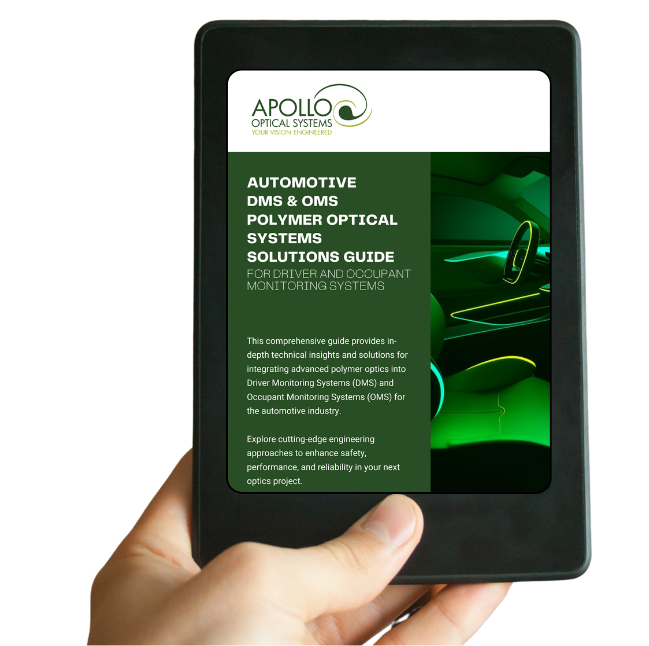
Automotive DMS & OMS Polymer Optical Systems Solution Guide
A complete solution guide for Driver andOccupant Monitoring Systems
Supporting Automotive Optical
Performance Early in Development
Automotive optical components operate in environments that differ significantly from laboratory optical systems. Optical windows, filters, and molded components must maintain stable performance across wide temperature ranges, long vehicle lifetimes, and high-volume manufacturing processes.
Temperature variation, vibration, material behavior, and high-volume manufacturing requirements all influence long-term optical performance in automotive systems. Understanding these factors early helps support stable, scalable production and reliable field performance.
Common Challenges Engineers Encounter in Automotive Polymer Optics
Developing automotive optical components requires careful coordination between optical performance, material behavior, injection molding processes, and mechanical integration. Many critical performance characteristics are evaluated and optimized during prototype development and early tooling refinement.
Common areas engineering teams evaluate include:
- Birefringence in injection-molded optical windows
- Gate location influence on optical performance
- Transmission stability in polymer IR filter windows
- ROI flatness requirements for camera sensor windows
- Optical performance across molding flow conditions
- Alignment between optical surfaces and mechanical datums
- Surface replication capabilities for molded optics
- Thermal expansion considerations for optical alignment
Understanding these factors early helps support long-term optical stability, manufacturability, and consistent performance throughout vehicle validation and production.
Apollo partners with automotive engineering teams to help optimize optical designs for real-world operating conditions, scalable manufacturing, and production-ready performance.
Deep Dive: Driver Monitoring Systems
Among automotive sensing systems, Driver Monitoring Systems represent one of the most demanding optical environments in modern vehicles.
These systems rely on near-infrared cameras and illumination to track driver attention, requiring stable optical transmission and alignment across temperature cycles and long vehicle lifetimes.
Small changes in optical stability can degrade sensor contrast, calibration accuracy, or algorithm performance.
Engineering Support for
Automotive Optical Programs
Apollo works with automotive engineering teams from early feasibility through production scaling.
Our capabilities include:
-
optical design for manufacturability
-
polymer optical material selection
-
in-house precision tooling and injection molding
-
optical metrology and validation
-
production-scale manufacturing
HOW APOLLO SUPPORTS AUTOMOTIVE OPTICAL DEVELOPMENT
Automotive optical systems require close coordination between optical design, materials, tooling, manufacturing, and validation. Apollo partners with engineering teams early in development to help support manufacturability, long-term optical stability, and scalable production performance.
Our team helps customers:
- Align optical performance with manufacturing requirements
- Evaluate material behavior across automotive operating environments
- Optimize designs for high-volume production
- Support validation and lifecycle performance objectives
- Improve consistency across complex optical systems
From prototype development through production scale-up, Apollo helps automotive teams bring advanced optical systems to market with greater confidence.
Whether you're developing a new sensing system or evaluating optical feasibility, our engineering team can help assess manufacturability and production risk early in development.