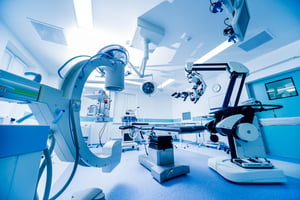

Medical Devices
Preventing Late-Stage Optical Failures in Medical Devices
Medical optical systems don’t fail loudly.They drift, degrade, and pass tests until they don’t.
Polymer optics make modern medical devices possible. Smaller systems, better integration, scalable manufacturing. But they also introduce time-dependent behavior, environmental sensitivity, and manufacturing variation that traditional validation often misses.
This is where the right partner matters. Because once these risks are embedded into the design or tooling, they are difficult and expensive to unwind.
Apollo works with teams early to identify where systems are likely to drift, degrade, or become unstable, and to resolve those risks before they become validation or field problems.

Medical Applications
for Polymer Optics
Polymer optics enable lightweight, scalable, and highly integrated medical systems. But in medical devices, optical instability can quickly become a validation, reliability, or patient safety issue. Apollo helps teams evaluate optical risk early so systems remain stable, manufacturable, and reliable at production scale.
-
Optical Covers
Protective optical covers for microscopes and diagnostic systems
that maintain transmission and image quality without introducing glare,
distortion, or stress-related optical issues. -
Medical Sensing
Polymer optics for pulse oximeters, PPG sensors, and monitoring systems
where optical stability and repeatability directly impact sensing accuracy
and device reliability. -
Position & Fiducial Markers
Optical tracking markers and retroreflectors for robotic surgery and
navigation systems requiring precise alignment, repeatability,
and stable optical performance. -
Endoscopes
Lightweight polymer optics for reusable and single-use endoscopic
systems designed for optical clarity, sterilization compatibility,
and scalable manufacturing.
Common Optical Risks
- Optical Drift Over Time
- Repeatability Across Production Lots
- Cleaning, Sterilization, and Chemical Exposure
- Cosmetic vs Clinical Optical Requirements
What goes wrong
Devices pass calibration and verification, then drift after months of use, storage, or environmental exposure.
Why it happens
Polymer optics are not static:
- Stress relaxation changes geometry over time
- Refractive index shifts with temperature and moisture
- Assembly constraints introduce slow deformation
Why this shows up late
Short-term verification looks clean.
The drift shows up during aging, validation, or in the field.
Where programs get stuck
At this stage, teams are often already past design freeze or tooling. Options become limited to compensation, not correction.
How Apollo helps
We work upstream to identify where drift will occur and how sensitive the system is to it. That allows teams to design in stability early, rather than trying to manage instability later.
What goes wrong
Parts meet dimensional and cosmetic specs, but optical performance varies lot to lot.
Why it happens
- Residual stress variation
- Surface replication inconsistency
- Process-driven distortion
Why this shows up late
Variation only becomes visible during system-level testing or integration.
Where this becomes a problem
At production scale, this turns into yield loss, inconsistent performance, and difficult root cause analysis.
How Apollo helps
We align design, tooling, and process assumptions early so that optical performance is not dependent on ideal conditions. The goal is consistency across cavities, lots, and time, not just prototype success.
What goes wrong
Optical performance degrades after sterilization or repeated cleaning cycles.
Why it happens
- Thermal and moisture exposure
- Chemical interaction with materials or coatings
- Accumulated stress over cycles
Why this shows up late
Sterilization is often validated mechanically or visually, not optically.
Where programs fail
Issues are discovered during validation or post-market, when design changes are highly constrained.
How Apollo helps
We evaluate material, coating, and geometry choices in the context of real sterilization environments early in development, so compatibility is designed in, not tested in at the end.
What goes wrong
Parts are optimized for appearance or over-specified cosmetically, introducing optical instability.
Why it happens
- Cosmetic standards override optical priorities
- Surface decisions ignore stress and distortion
- Rework introduces variability
Why this shows up late
Cosmetic decisions are often locked before full optical validation.
The hidden risk
Teams can unknowingly trade optical performance for appearance, especially without a partner who understands how these decisions interact.
How Apollo helps
We help teams distinguish what actually matters optically versus what is purely cosmetic, so decisions support clinical performance, not undermine it.
HOW APOLLO HELPS PREVENT THESE FAILURES
Most of these issues are not caused by a single mistake.They come from small decisions made across design, material selection, tooling, and validation. Apollo works across those interfaces early, before they turn into late-stage problems.
Apollo is ISO 13485-2016
(Medical Device Quality Management)
certified.
Optical Design for Stability,
Not Just Performance
We support optical designs that prioritize: Stability over time, Environmental robustness and Predictable behavior under constraint.
This includes early identification of surfaces and features that are optically critical versus cosmetically relevant.
Material selection is evaluated against:
-
Optical performance
-
Stress sensitivity
-
Moisture uptake
-
Chemical resistance
-
Sterilization compatibility
Tradeoffs are made explicit early, before regulatory and tooling decisions lock in risk.
We support tooling and process strategies that emphasize:
-
Repeatable flow behavior
-
Controlled stress distribution
-
Surface replication robustness
-
Realistic process windows
The goal is not theoretical perfection, but clinically consistent performance.
Validation strategies are developed to support:
- Design verification
- Process validation
- Change control
- Risk management documentation
Optical performance is evaluated as a functional requirement, not an afterthought.
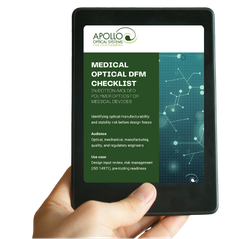
Medical Optical DFM Checklist
This checklist helps you identify optical manufacturability and stability risks before they become regulatory or patient safety issues.The Gap Between Design and
Reality in Medical Optics
Most medical optics programs don’t fail because teams lack expertise. They fail because risk is distributed across disciplines and shows up too late.
- Design assumes ideal material behavior
- Manufacturing assumes design robustness
- Validation assumes stability
No one owns the interaction between them. That’s the gap.
Apollo works at that intersection, helping teams:
- Identify failure modes early
- Align design with manufacturing reality
- Validate performance under real conditions
Because once tooling, validation, and regulatory paths are locked, the cost of fixing optical issues increases dramatically.
Medical device companies partner with us to help them meet their challenging optical requirements for a variety of applications. Polymer optics offer advantages to device manufacturers such as:
- Low cost and lightweight
- Chemically stable and Non Toxic
- Flexible mechanical designs allow features such as mounting or positioning fiducials
ASK US ABOUT OUR HIGH VOLUME MANUFACTURING CAPABILITIES
APOLLO OFFERS IN-HOUSE EXPERTISEOur engineers are highly experienced in designing for the best outcomes, performance and cost savings when it comes to medical device improvements.