A scratch-resistant coating on polycarbonate lenses is only “good” if it remains clear and functional after real handling, cleaning, assembly contact, and environmental exposure.
The practical challenge is that polycarbonate is more damage-sensitive than glass, and many coating stacks that look acceptable on coupons degrade differently on real parts due to adhesion behavior, surface preparation, and process variation.
This guide explains how scratch-resistant coatings for polycarbonate are typically built (hardcoats with optional functional layers), what failure looks like in real use (haze growth, abrasion marking, edge defects, adhesion loss, optical drift), and how to select tests and acceptance thresholds that match your actual wiping, cleaning chemistry, handling, and environment, not generic abrasion claims.
You’ll also get a qualification flow from early coupon screening to release-ready proof on representative parts, with measurements that can be repeated in production inspection.
Key Takeaways
Hardcoat selection should start from the use threats (wiping, particulates, cleaners), not coating names.
Scratch resistance must be tied to measured drift (haze/scatter/optical performance), not visual inspection alone.
For polycarbonate lenses, cleaning chemistry, adhesion/edge behavior, and thermal/handling effects often decide real-world durability.
A qualification plan is incomplete without pass/fail thresholds, sampling, and requalification triggers.
Why Polycarbonate Scratches and What “Scratch-Resistant” Should Mean?

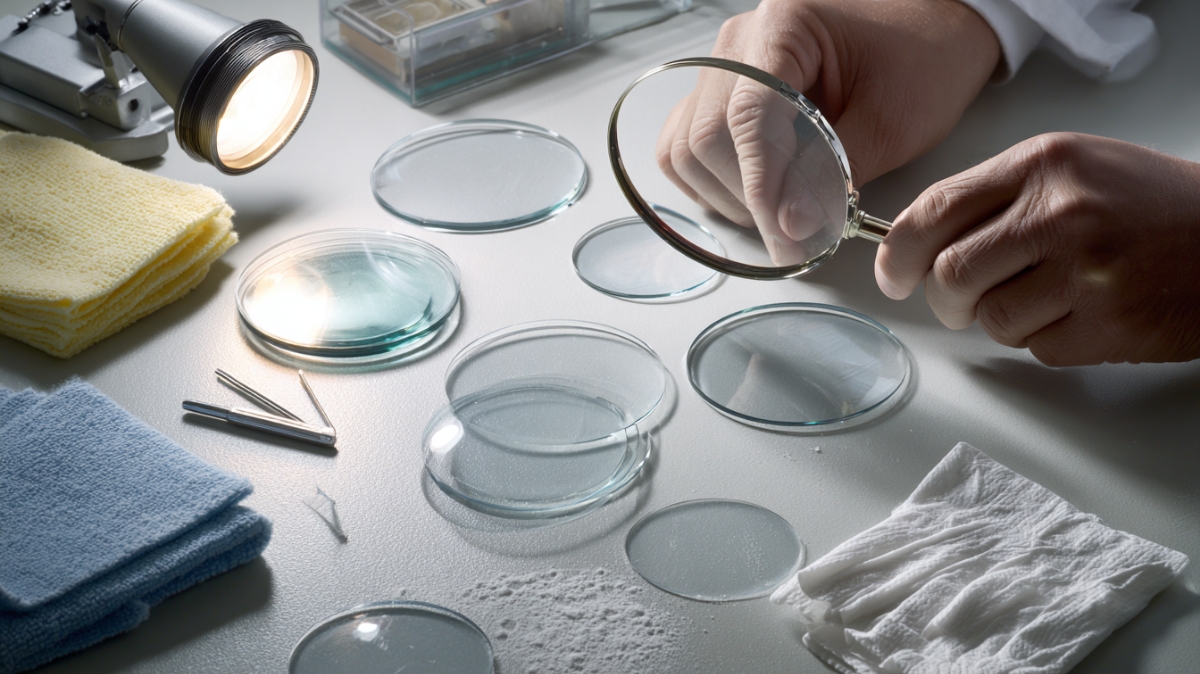
Polycarbonate scratches easily because the substrate is mechanically softer than glass, and real-world damage is driven by routine contact: wiping, handling, and particulate drag.
Even careful cleaning can introduce micro-marring when dust is present, and that wear can accumulate into visible haze over time.
To avoid confusion in coating selection and qualification, it helps to separate three terms that are often treated as interchangeable:
Scratch (localized cosmetic mark): visible under certain lighting/angles.
Mar/abrasion (distributed wear): micro-damage from repeated contact (often wiping).
Haze/scatter drift (functional loss): measurable optical consequence that reduces clarity/contrast.
In practical programs, “scratch-resistant” should not mean “no marks under all handling.” It should mean slower measurable degradation under the contact and cleaning conditions the product will actually experience. For polycarbonate lenses, scratch-resistance is typically evaluated as one or more of the following outcomes:
Reduced haze growth after representative wipe cycles
Improved mar resistance under realistic contact pressures and materials
Better cleanability, where routine cleaning does not rapidly accumulate visible wear
Stable optical performance, where transmission/reflectance and scatter remain within defined limits after exposure
This is also where tradeoffs matter. Increasing surface durability can introduce secondary risks that must be managed at the system level, such as slight clarity penalties, sensitivity to stress or flexing, or incompatibility with certain cleaners and disinfectants.
The correct target is not “the hardest coating,” but the coating system that stays within acceptable optical and cosmetic limits under real use threats.
Once “scratch-resistant” is framed as a measurable, use-case-specific outcome, the next step is selecting the coating families and stack approaches that can deliver it on polycarbonate.
What are the Coating Options for Polycarbonate Lenses?

Most scratch-resistant solutions for polycarbonate start with a hardcoat foundation, then add optical layers (e.g., AR) or surface-function layers (e.g., oleophobic/anti-fog) when needed.
These options are often compared as if they’re interchangeable, but they behave differently because they rely on different chemistries, thickness ranges, and adhesion interfaces.
Practical note on application methods: “dip” vs “flow” (and similar labels) matters mainly for what it enables: thickness uniformity, edge behavior, and process repeatability, not the label itself.
Scratch-Resistant Coating Options for Polycarbonate Lenses: What They Improve and What They Trade
Category | Siloxane hardcoat | UV-cured / hybrid hardcoat | AR + hardcoat stack | Hardcoat + top-layer add-ons (oleophobic/anti-fog) | Pre-coated substrate approach (when applicable) |
|---|---|---|---|---|---|
Best fit (threat profile) | Frequent wiping/handling + cosmetic sensitivity | Throughput/temperature constraints + moderate durability needs | Optical performance must be preserved, + durability is required | Cleanability/anti-smudge/anti-fog is critical | High volume form factors with standardized durability needs |
What it improves | Mar resistance; slows haze growth | Faster processing; tunable hardness | Reflectance/transmission control + scratch resistance | Easier cleaning; reduces smudge retention | Process simplification; consistency is controlled |
Common tradeoffs | Edge behavior: adhesion depends heavily on prep and cure | Chemical sensitivity can dominate; long-term wipe durability varies | More interfaces = higher adhesion/environmental sensitivity | The top layer can wear first; chemistry compatibility becomes critical | Still subject to handling/assembly damage; limited stack flexibility |
What to measure to confirm | Pre/post haze/scatter proxy; cosmetic mapping in zones; adhesion checks after exposure | Chemical exposure + wipe cycles; pre/post haze; cosmetic growth tracking | Pre/post spectral (band); haze/scatter drift; defect mapping after humidity/thermal | Wipe-cycle wear on top layer; contact-angle/functional checks; haze/cosmetics | Incoming QC + pre/post durability confirmation on real parts |
Typical failure mode if misapplied | “Passes abrasion demo,” but haze grows in real cleaning cycles or edge defects appear | Early degradation under real cleaners despite good abrasion numbers | Optically “in spec” at time zero, then drift after cycling/cleaning | Scratch-resistant base holds, but the top layer fails → cleaning becomes abrasive | “Qualified” substrate, but assembly handling creates field-visible wear |
Key constraint to keep in mind: scratch resistance is rarely a single-layer claim. Across all options, durability is a stack + substrate + process problem—surface preparation, cure/thickness control, edge behavior, and real cleaning/handling usually determine whether haze and cosmetics stay stable.
With the option set defined, the next step is matching the coating approach to your real threats and failure modes, so qualification effort is spent proving the right risks, not just running generic abrasion checks.
How to Choose the Right Scratch-Resistant Coating for Polycarbonate Lenses?

A scratch-resistant coating choice only works when it is tied to the threats your polycarbonate lens will actually face and the performance you must protect.
A stack that looks strong in a controlled abrasion demo can still fail in service if the dominant risk is chemical cleaning, repetitive wiping, particulate drag, or thermal exposure.
For polycarbonate, selection should be framed around what must remain stable over time, typically haze growth, scatter, and optical clarity under real handling and maintenance, not around a single abrasion number taken out of context.
Build a Threat Profile Before You Compare Coatings
Start by documenting the use conditions that actually drive surface damage and optical drift:
Contact and wiping: what touches the lens (cloth type, gloved hands, dry wipe vs wet wipe), how often, and whether pressure is controlled or variable.
Particulate risk: dust/sand exposure, contamination during assembly, and whether wiping occurs while particles are present.
Cleaning chemistry: detergents, disinfectants, solvents, or specialty cleaners; include concentration, dwell time, and whether cleaning is wipe-based or soak-based.
Environment: humidity/condensation cycles, temperature swings, UV exposure (if applicable), and storage conditions.
Handling realities: assembly steps, fixtures, packaging contact points, and whether protective films are used.
A practical shortcut is to identify the single most frequent exposure (usually wiping/cleaning) and the single most severe exposure (often a chemical or environmental condition), then select around those.
Decide What “Failure” Means for Your System
Polycarbonate programs commonly fail one of two ways, and the “best” coating differs depending on which one matters most:
Cosmetic-limited: minor marks are unacceptable because the lens is user-facing, aesthetic, or inspected visually at close range. In these cases, the priority is mar resistance and controlled appearance after wiping.
Performance-limited: the lens is part of an optical system where small surface changes degrade function. Here, the priority is preventing haze/scatter growth and maintaining the optical metric that matters to the system.
This is where many selections go wrong: a coating can look “fine” cosmetically but still introduce enough scatter or haze drift to degrade contrast, signal quality, or image uniformity.
Match the Coating Direction to the Dominant Threat
Once you know what the lens must survive, selection becomes a fit problem:
If repeated wiping dominates: prioritize coatings that resist haze growth under realistic wipe conditions, not just isolated scratch demos.
If particulates + wiping dominate: prioritize resistance to particle drag and damage progression after cleaning cycles, since particulates often create the real wear mechanism.
If cleaning chemicals dominate: prioritize chemical compatibility first. A coating that is strong against abrasion but sensitive to your cleaner will fail early in service.
If condensation/humidity dominates: ensure the stack does not show haze formation, adhesion loss, or defect growth after exposure cycles representative of the product lifecycle.
Know When Coupons Are Informative and When They Are Misleading
Coupons are valuable for early screening, but polycarbonate lenses often need qualification on parts when geometry and finish influence outcomes. Move beyond coupons when:
Edges, apertures, or local curvature change how the coating behaves or fails.
The molded surface finish differs from the coupon finish (which is common).
The lens experiences real packaging or fixturing contact that the coupon never sees.
Cosmetic acceptance is tight, and inspection conditions are strict.
If the expected failure in the field is edge-driven, handling-driven, or assembly-driven, coupon-only confidence is usually not release-ready.
When Chemical Resistance Should Outrank Abrasion Numbers
For polycarbonate, cleaning and disinfectant exposure often determines field life. If your use case involves aggressive chemistries or frequent cleaning, treat this as a gating criterion:
If the chemistry can soften, swell, or destabilize the surface, abrasion performance becomes irrelevant because the failure mechanism changes.
A robust choice is the one that maintains clarity and adhesion after realistic chemical exposure and then survives wiping cycles.
In other words: if chemistry is real, qualify chemistry first then abrasion.
Early “Stop Signs” That Force a Different Approach
Certain signals indicate you need to reconsider the coating direction, the maintenance plan, or the acceptance criteria before investing in deeper qualification:
Your required cleaning chemistry is incompatible with polycarbonate or the expected coating stack.
The coating shows haze/scatter growth before obvious cosmetic scratches appear.
Minor handling steps cause visible marking that cannot be controlled operationally.
You cannot define a measurable pass/fail metric that aligns with how the lens will be inspected or verified.
If any of these are present, the “best” option may not be a different coating it may be a change in cleaning method, protective strategy, surface finish targets, or the overall system requirement.
Once you have a coating direction that fits the threat profile, the next step is to ensure the result is controllable in the real build, because polycarbonate outcomes often depend as much on substrate condition and process assumptions as on the coating choice itself.
What to Specify to a Coater?

A scratch-resistant coating program succeeds or fails on what is specified upstream. If the substrate condition, cosmetic zones, edge geometry, masking, and handling steps are ambiguous, the coating can be “correct” on paper and still vary build-to-build or fail for reasons the coating stack cannot fix.
Start with the substrate inputs that change coating behavior on polycarbonate.
Polycarbonate grade, molding history, and residual stress can influence adhesion, crack initiation, and the visibility of cosmetic markings.
Surface state matters just as much: a molded finish, a post-polished finish, or a diamond-turned finish can behave differently under the same coating process and the same durability exposure.
Next,
Define what “representative” means for your part, not for an ideal coupon.
Coaters can only control what they can see in the requirements: edge features, apertures, curvature transitions, and cosmetic zones must be explicitly identified.
Masking regions and coating boundaries should also be defined up front, because edge behavior often dictates where defects initiate and how they propagate after wiping or cycling.
Handling assumptions should be treated as part of the specification, not as “process detail.”
If protective films are used, define when they are applied and removed.
If pre-coat cleaning is expected, specify the cleaning method and any chemistry restrictions.
If post-coat assembly includes contact points, fixtures, or cleaning steps, those interactions must be acknowledged because they are often the real source of scratching and haze growth even when the coating itself is performing as designed.
Finally,
Translate “scratch resistance” into explicit, measurable requirements that a coating process can be built around.
Define the optical performance window that must be preserved, the maximum allowable haze/scatter drift you can tolerate, and which cosmetic criteria apply in which zones.
Pair this with change-control rules: identify what changes (substrate grade, surface prep, coating process conditions, masking approach) trigger requalification so the durability you qualify is the durability you keep.
Once these inputs are locked, the next step is designing a qualification plan that measures durability and drift in a way that production inspection can repeat.
How to Test Scratch Resistance Without Misleading Results

A scratch-resistance qualification plan is only credible when it measures the degradation modes that matter to the system and ties them to repeatable pass/fail criteria.
For polycarbonate, the most common field failure is not a single visible scratch; it is cumulative haze/scatter growth and cosmetic marking driven by cleaning and handling.
If those outcomes are not measured directly, the plan can “pass” while the lens degrades in service.
1) Establish Measurement Anchors (Pre- and Post-Exposure)
Use the same measurement set before and after every exposure so changes are attributable and comparable.
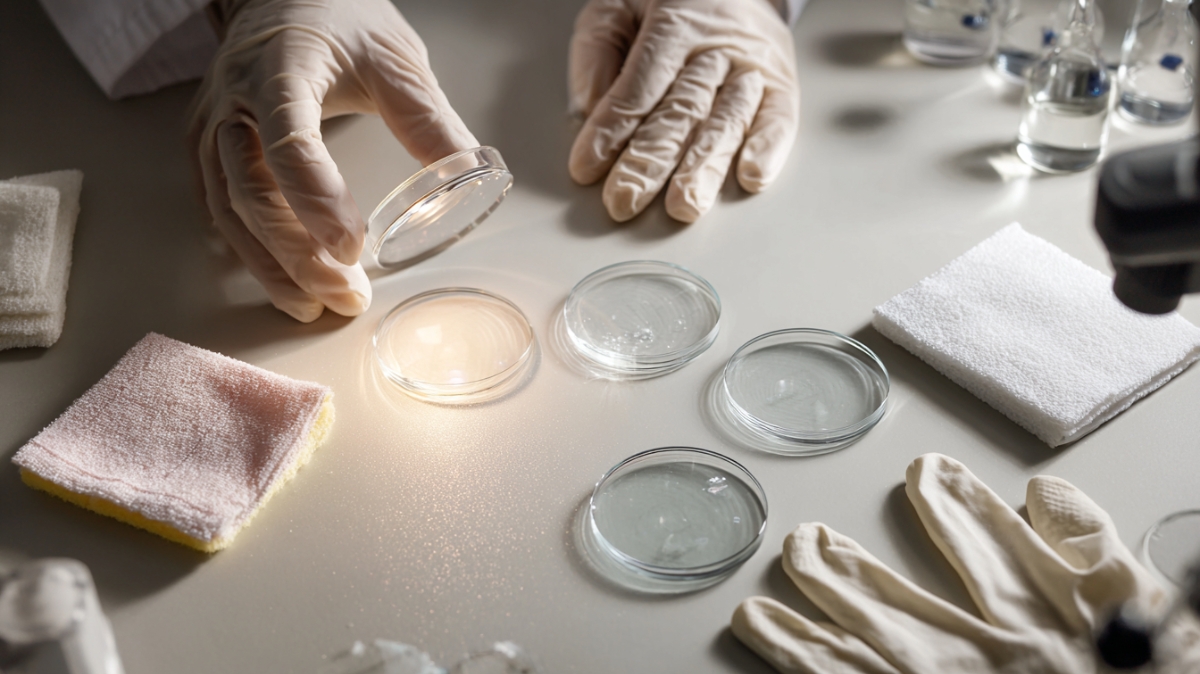
Haze or scatter proxy (pre/post): select one repeatable method and lock the setup (illumination geometry, viewing angle, distance, and sample orientation). If scatter metrology is not available, define a controlled proxy that can be reproduced consistently.
Cosmetic mapping and controlled imagery (pre/post): record defect type, location, and growth in defined cosmetic zones using controlled lighting and documentation rules.
Spectral transmission/reflectance checks (as applicable): when the lens has optical-function requirements (AR, filtering, throughput), measure the functional metric tied to performance, not appearance alone.
2) Define Pass/Fail Using Two Layers: Optical Drift and Cosmetic Drift
Qualification commonly fails when visual inspection is treated as the acceptance criterion.
Optical drift criteria: define allowable change in the functional metric (haze/scatter proxy and, where relevant, spectral performance) as a numerical threshold.
Cosmetic drift criteria: define what constitutes a defect, where it is evaluated, and how it is recorded (zones, size limits, defect categories, and inspection conditions).
Interpretation discipline: a part can be cosmetically acceptable yet optically degraded, or cosmetically marked while still meeting optical metrics. Both conditions must be addressed explicitly.
3) Keep the Exposure Plan Minimal and Defensible
A qualification plan should be lean by design: the smallest set that reliably exposes the dominant risks.
One exposure per dominant threat:
contact/wiping (cleaning and handling)
chemical exposure (actual cleaners/disinfectants, concentration, and method)
humidity/condensation (when present in storage or use)
thermal swings (when present in use or processing)
Plus one sequential run that mirrors lifecycle: a short sequence reflecting the order of real stresses (e.g., humidity/thermal → cleaning wipes → inspection).
Add tests only when justified: when a failure mode cannot be isolated, a customer/specification explicitly requires it, or the system risk warrants additional evidence.
4) Use Witness Samples Selectively and Escalate When Necessary
Witness coupons are efficient for early screening and process monitoring, but they do not always represent real polycarbonate parts.
Witness coupons are appropriate when comparing candidate stacks, monitoring process stability, and ranking relative abrasion behavior under controlled conditions.
Witness coupons are insufficient when edges, apertures, molded finish, or assembly handling points drive failure, or when cosmetic requirements are tight.
Escalate to representative parts when geometry, finish state, or packaging/handling conditions are expected to dominate performance and appearance outcomes.
5) Require Documentation That Supports Release Decisions
Durability results must be reproducible and reviewable, not merely positive.
Defect maps and controlled photos tied to defined cosmetic zones
Exposure conditions (wipe media, load, cycles; chemistry, concentration, dwell; humidity/temperature profile)
Inspection method controls (lighting, magnification, viewing angles, and pass/fail rules)
Pre/post measurement records showing drift explicitly rather than relying on narrative assessment
Once testing produces repeatable pre/post evidence aligned to real threats, the remaining requirement is release readiness, demonstrating that results hold across samples, lots, and the intended production inspection flow.
Release Readiness Checklist for Scratch-Resistant Polycarbonate Lenses

A scratch-resistant coating on polycarbonate is “release-ready” only when the qualification result will hold across real builds, not just on a successful sample set. Use the checklist below to confirm the plan is tied to real threats, measured repeatably, and protected against silent changes.
Threats are Defined and Mapped to Tests
Contact and wiping conditions are documented (wipe media, frequency, particulate exposure).
Cleaning chemistry and method are defined (agent, concentration, wipe vs soak, dwell time).
Environmental exposure is defined (humidity/condensation risk, temperature range/cycling), with a test mapped to each threat.
Test Articles are Representative
The polycarbonate grade and surface finish state match the intended build.
Geometry and cosmetic zones are represented (edges, apertures, masked areas, “no-defect” regions).
Handling and fixturing reflect real contact points (protective films, assembly touch points, cleaning practice).
Pass/Fail is Measurable and Repeatable
Optical drift limits are defined (haze/scatter proxy; spectral checks if optical function is critical).
Cosmetic criteria are defined with controlled inspection conditions (lighting, angles, defect mapping rules).
The measurement method is repeatable in the intended inspection flow, not dependent on operator judgment.
Sampling Supports a Release Decision
Sample count and lot/build coverage are defined (single lot vs multiple lots; coupon vs part mix).
Retest and containment rules are written before running the qualification (what triggers a rerun and what changes are acceptable).
Requalification Triggers are Set
Substrate/material or prep changes.
Coating stack/process/deposition changes.
Cleaning chemistry or method changes (chemical, concentration, wipe material, frequency).
Packaging, handling, or assembly changes that alter stress or contact risk.
If your release checklist is exposing risk, especially around real-part repeatability, cleaning chemistry compatibility, or pass/fail thresholds that are difficult to measure consistently, this is typically where a manufacturing-led coating qualification review prevents late-stage churn.
Apollo Optical Systems: Making Scratch-Resistant Coatings Release-Ready on Polycarbonate
Apollo Optical Systems supports scratch-resistant coating qualification for polycarbonate lenses by keeping the work tied to production reality so the coating stack you select can be qualified, verified, and repeated on real parts at scale, not just demonstrated on coupons.
Threat-to-test plan that reflects real use
Converts your wiping media and frequency, particulate exposure, and cleaning chemistry into a qualification plan that reproduces the actual failure drivers (haze growth, abrasion marking, edge defects, adhesion loss) instead of generic abrasion demos.
Polycarbonate-specific robustness, not generic “hardness” assumptions
Accounts for PC behavior that commonly breaks durability in the field, chemical sensitivity, thermal limits, surface condition variability, and handling/fixturing contact so the coating remains stable through real maintenance and assembly.
Evidence strategy that prevents coupon-only confidence
Defines what can be screened on witness coupons versus what must be proven on representative parts (geometry, edges, molded finish, cosmetic zones), so sign-off is based on the same build realities production will see.
Verification that production can repeat
Establishes measurable pass/fail criteria and inspection methods (pre/post haze or scatter proxies, controlled cosmetic mapping, and optical checks where required) that can be executed consistently in the intended production inspection flow.
Use the threat-to-coating selection logic and the release checklist in this guide to draft a one-page coating qualification brief.
If your plan depends on aggressive cleaning chemistry, tight cosmetic limits, or representative-part behavior, schedule a short coating qualification review with Apollo Optical Systems before you lock the stack.
Conclusion
Scratch-resistant coatings for polycarbonate lenses are best treated as a qualification exercise, not a label choice.
When coating selection is driven by real threats and validated with measurable optical and cosmetic thresholds on representative parts, scratch resistance becomes a controlled release decision rather than a field surprise.
The practical path is consistent: define what “pass” means, keep the exposure set lean but defensible, and lock the stack only once repeatability is demonstrated at the scale you intend to ship.
FAQs
What is the best scratch-resistant coating for polycarbonate lenses?
“Best” depends on the threat profile and what drift you can tolerate. Most systems start with a hardcoat, then add functional layers only as needed. The right choice is the one that holds acceptable haze/clarity and cosmetic performance under your actual wiping, dust, and cleaning chemistry.
Do scratch-resistant coatings wear off on polycarbonate?
They can degrade with repeated wiping, abrasive particulate exposure, and incompatible cleaners. That is why qualification should include repeated-contact exposure and pre-/post-measurements, not a one-time visual check.
How do you test scratch resistance on coated polycarbonate lenses?
Use contact/abrasion exposures that represent real wiping and particulate risk, then measure pre-/post-drift. Common anchors include haze/scatter proxy measurements and controlled cosmetic mapping, plus spectral checks if transmission/reflectance performance matters.
Can you apply an anti-scratch coating to polycarbonate after molding?
Yes—many scratch-resistant solutions are applied post-mold. Performance depends on surface condition, preparation, geometry, and handling controls, which is why coupon-only tests can overestimate real-part durability.
Does a scratch-resistant coating affect optical clarity?
It can. Some coating stacks introduce haze/scatter drift, reflectance changes, or visible artifacts under certain lighting. Defining optical and cosmetic acceptance thresholds up front prevents “durable” from becoming “optically unacceptable.”