Top Precision Components Manufacturing Companies: 2026 Guide

One wrong manufacturing partner can quietly turn precision into liability, and most businesses realize it only after costs, delays, or recalls hit. 

Precision components sit at the core of today's most regulated and performance-driven industries, from medical devices to aerospace and automotive. In fact, the global precision parts market was valued at ~$226 billion in 2024 and is expected to exceed $323 billion by 2031, driven by tighter tolerances, miniaturization, and compliance demands.

Yet manufacturers continue to face challenges around supplier scalability, quality consistency, and regulatory readiness, especially as supply chains grow more complex.

That’s why understanding the top precision components manufacturing companies matters. In this guide, we’ll walk you through who leads the market, what truly differentiates them, and how businesses like yours can choose partners built for long-term performance. 

Key Takeaways

  • Precision manufacturing success depends on process ownership and tolerance control, not just machining capability or scale.

  • Different applications require different partners, optics, micro-scale, metals, and plastics; each demand specialized expertise.

  • Scale-up is the highest-risk phase, where mismatched prototyping, tooling, or coatings cause most failures.

  • Vertically integrated manufacturers reduce handoffs, redesigns, and compliance gaps, especially in regulated industries.

  • Polymer optical components are increasingly preferred for lightweight, durable, and high-volume sensing applications.

  • For optics-driven and regulated products, optics-first partners like Apollo Optical Systems consistently lower risk and time-to-market.

What Are Precision Components & Why They Matter

What Are Precision Components & Why They Matter

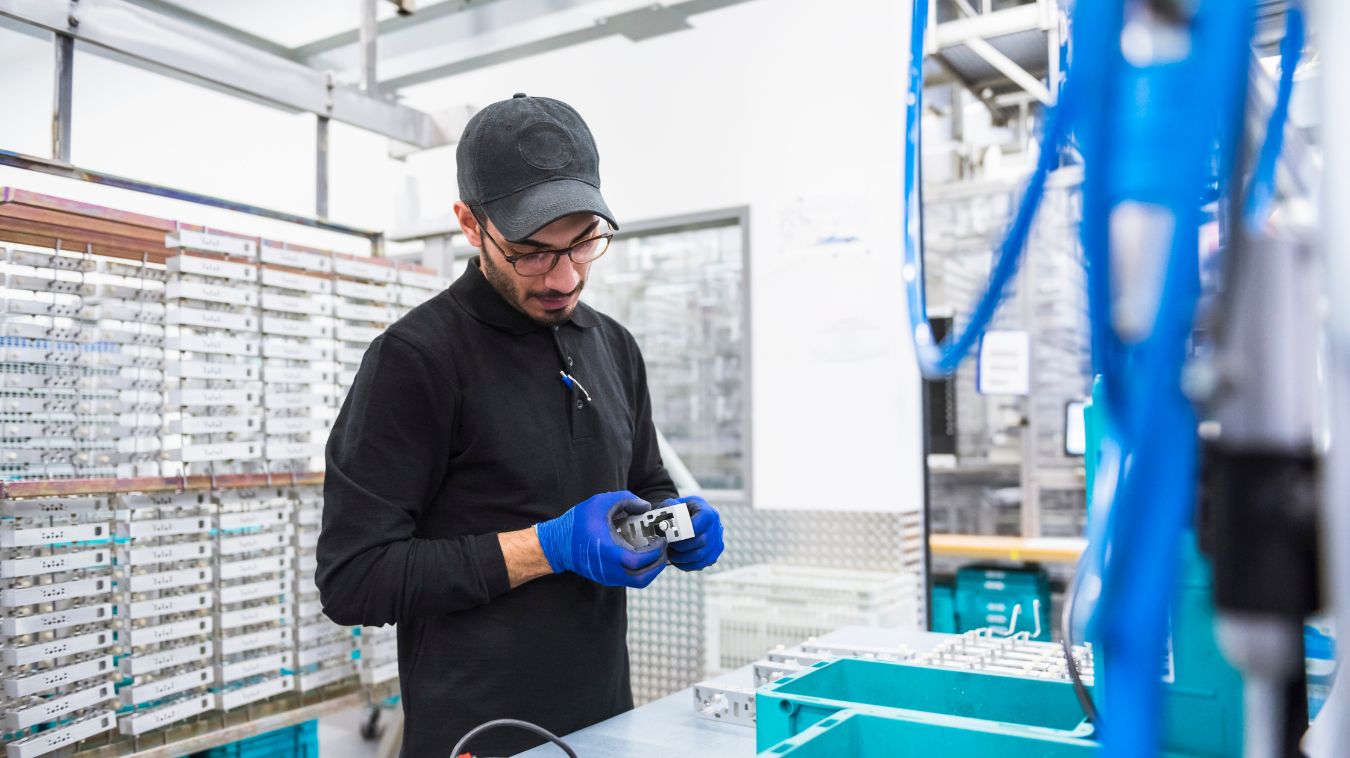
Precision components are engineered parts manufactured to extremely tight tolerances, where even micron-level deviations can compromise functionality, safety, or regulatory approval. Unlike standard components, precision parts are designed to fit and to perform consistently under defined optical, mechanical, thermal, or environmental conditions.

These components are produced using advanced methods like CNC machining, grinding, and laser cutting to achieve tight tolerances and consistent quality across thousands of identical pieces. 

Typical precision components include:

  • Shafts, gears, bushings, and fasteners are used in engines and drive systems.

  • Tiny medical parts like surgical instrument tips, implants, and diagnostic device elements.

  • Aerospace parts such as turbine blades, landing gear elements, and control system housings.

​These parts are usually made from materials like stainless steel, titanium, aluminum, or engineered plastics chosen for strength, heat resistance, or biocompatibility, depending on where they will be used.

Why Precision Components Matter to Businesses?

For OEMs, precision components are not isolated parts; they directly affect product reliability, regulatory risk, and total cost of ownership. Here’s how precision impacts real business outcomes:

  • Performance and safety: In aerospace and medical devices, a small dimensional error can lead to part failure, equipment malfunction, or safety risks, so micron-level accuracy is required.

  • Reliability and lifespan: Well-made precision parts reduce wear, vibration, and misalignment, thereby reducing unplanned downtime and extending machine life in sectors such as automotive, power, and manufacturing.

  • Consistency at scale: Precision manufacturing allows thousands of identical parts to be produced with the same dimensions, which is essential for assembly lines and global spare-parts supply.

  • Cost and efficiency: Accurate parts reduce rework, scrap, and fitting issues, making production faster and more cost-effective while supporting just‑in‑time manufacturing.

Not every manufacturer claiming “precision” can meet these demands consistently and at scale. Understanding what precision components truly involve helps businesses evaluate suppliers based on capability depth, not marketing claims.

Once you understand what makes a component truly “precision-grade,” the next challenge is knowing how to separate capable vendors from those simply using the label.

How to Evaluate Precision Parts Vendors That Can Perform at Scale

How to Evaluate Precision Parts Vendors That Can Perform at Scale

Not all precision parts vendors are built to support real-world production demands. The strongest suppliers combine engineering depth, manufacturing control, and quality systems that hold up beyond prototypes. 

Below are the non-negotiable criteria businesses should use when evaluating top precision components manufacturing companies.

1. Engineering & Design-for-Manufacturing (DFM) Capability

Precision issues often begin at the design stage. Vendors that only “build to print” expose you to downstream failures. Look for vendors that offer:

  • Optical and mechanical design support, not just manufacturing

  • DFM reviews to flag tolerance stack-ups, tool limitations, and cost drivers early

  • Tolerance analysis and design verification before tooling or production begins

2. Manufacturing Process Control (Not Just Equipment)

Owning machines is not the same as controlling processes. Evaluate vendors on:

  • Proven ability to maintain tight tolerances repeatedly, not just on first articles

  • Documented process parameters for molding, machining, or micro-features

  • Capability to transition from prototyping to high-volume production without redesign.

Confirm they have multi-axis CNC machines (5-axis or higher), EDM, and grinding tools capable of tolerances like ±0.0005 inches and surface finishes Ra < 0.8 µm. Ask for machine lists and capacity for your part volumes.

3. Materials Expertise Aligned to Application

Precision is inseparable from material behavior. Strong vendors demonstrate:

  • Experience with application-specific materials (optical polymers, metals, or hybrids)

  • Understanding of thermal stability, chemical resistance, and optical clarity

  • Guidance on material trade-offs affecting cost, durability, and compliance

4. Quality Systems & Certification Depth

Precision without traceability is a liability, especially in regulated markets. Assess:

  • Relevant certifications (ISO 9001, ISO 13485 for medical, AS9100 for aerospace)

  • In-process inspection and metrology, not only final checks

  • Documented corrective action and continuous improvement processes.

Defect rates should be under 0.5%; request SPC charts and in-process inspection data.

5. Vertical Integration & Supply Chain Control

Fragmented suppliers increase risk and variability. Prefer vendors that provide:

  • In-house manufacturing, coating, and assembly

  • Reduced dependency on third-party subcontractors

  • Single-point accountability for quality and delivery.

6. Scalability & Long-Term Partnership Fit

A vendor that works for today's volume may fail tomorrow. Confirm:

  • Capacity to support thousands to millions of parts

  • Stable tooling and process ownership

  • Experience supporting long product lifecycles and design revisions

Selecting the right vendor means evaluating against proven standards, but seeing top performers in action shows exactly what excellence looks like in precision components manufacturing for 2026.

Top 10 Precision Components Manufacturing Companies (2026)

Top 10 Precision Components Manufacturing Companies (2026)

Below are 10 world-class companies selected for their demonstrated capability in precision engineering, tight tolerances, vertical integration, and industry relevance.

1. Apollo Optical Systems (USA)

https://www.apollooptical.com/

Apollo Optical Systems is a precision polymer optics manufacturing partner built specifically for OEMs that require optical accuracy, regulatory compliance, and scalable production under one roof.

Apollo operates as an optics-first contract manufacturer, supporting programs from early optical design through high-volume injection molding and finished optical assemblies.

Core Services & Technical Capabilities

  • Optical & Mechanical Design: In-house optical modeling, mechanical design, DFM reviews, and tolerance analysis to ensure designs scale without optical degradation.

  • Rapid Prototyping: Single Point Diamond Turning (SPDT) for fast, high-precision optical prototypes that closely match production geometry.

  • High-Volume Manufacturing: Precision polymer injection molding optimized for repeatability across thousands to millions of parts.

  • Advanced Optical Components: Aspheric lenses, Fresnel optics, diffractive optics, microlens arrays, source-hiding windows, and reflectors.

  • Coatings & Assembly: Evaporative and AR coatings, component bonding, sub-system and optical assembly, all performed in-house.

  • Metrology & Testing: Optical inspection and validation systems supporting tight tolerances and compliance documentation.

Key Strengths That Set Apollo Apart

  • Polymer optics specialization: Proven expertise in optical-grade polymers (Zeonex, Zeonor, Acrylic, Ultem) for lightweight, durable, and cost-efficient precision components.

  • Prototype-to-production continuity: SPDT-validated designs transition directly into injection molding, minimizing redesign and scale-up risk.

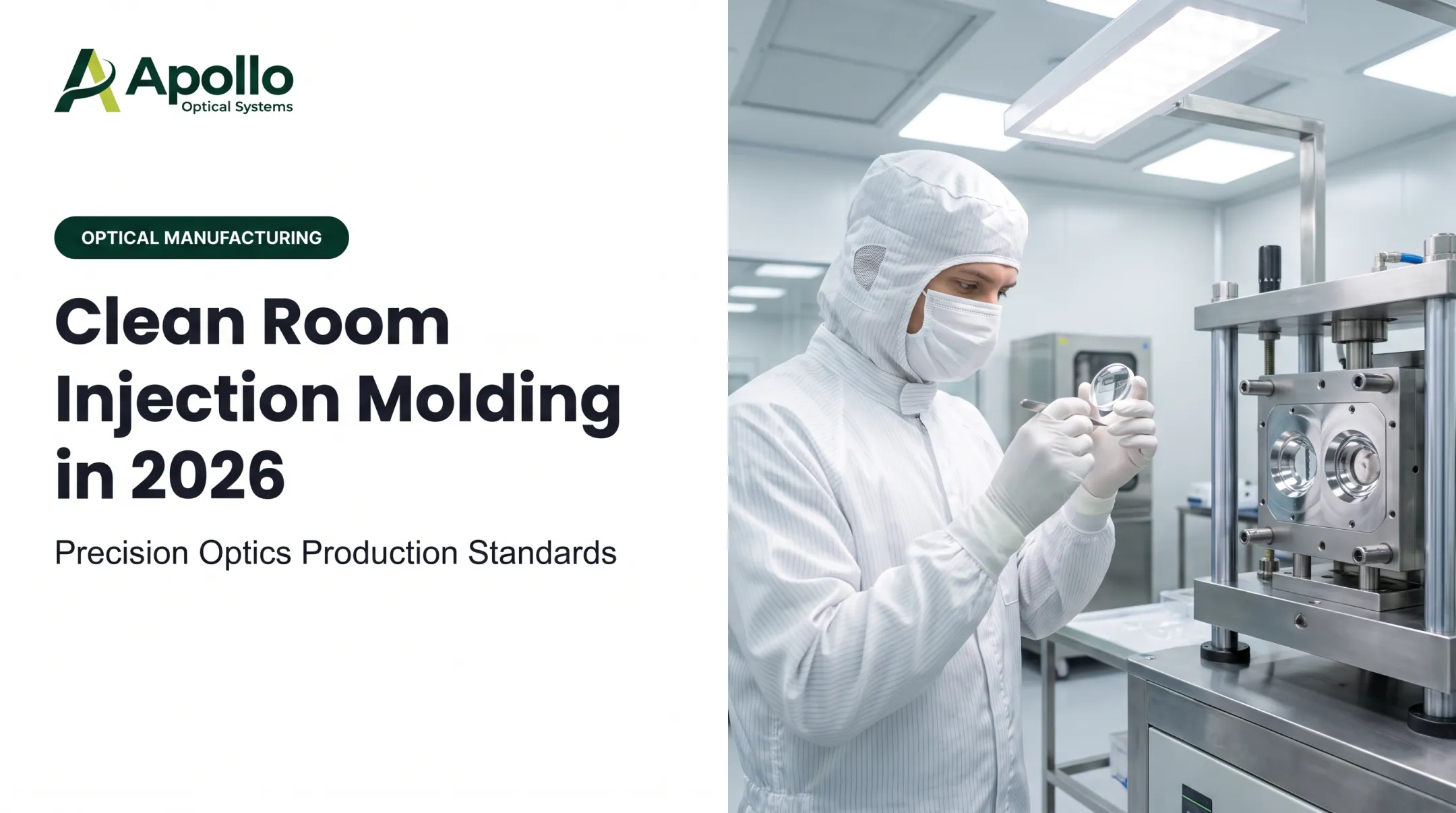
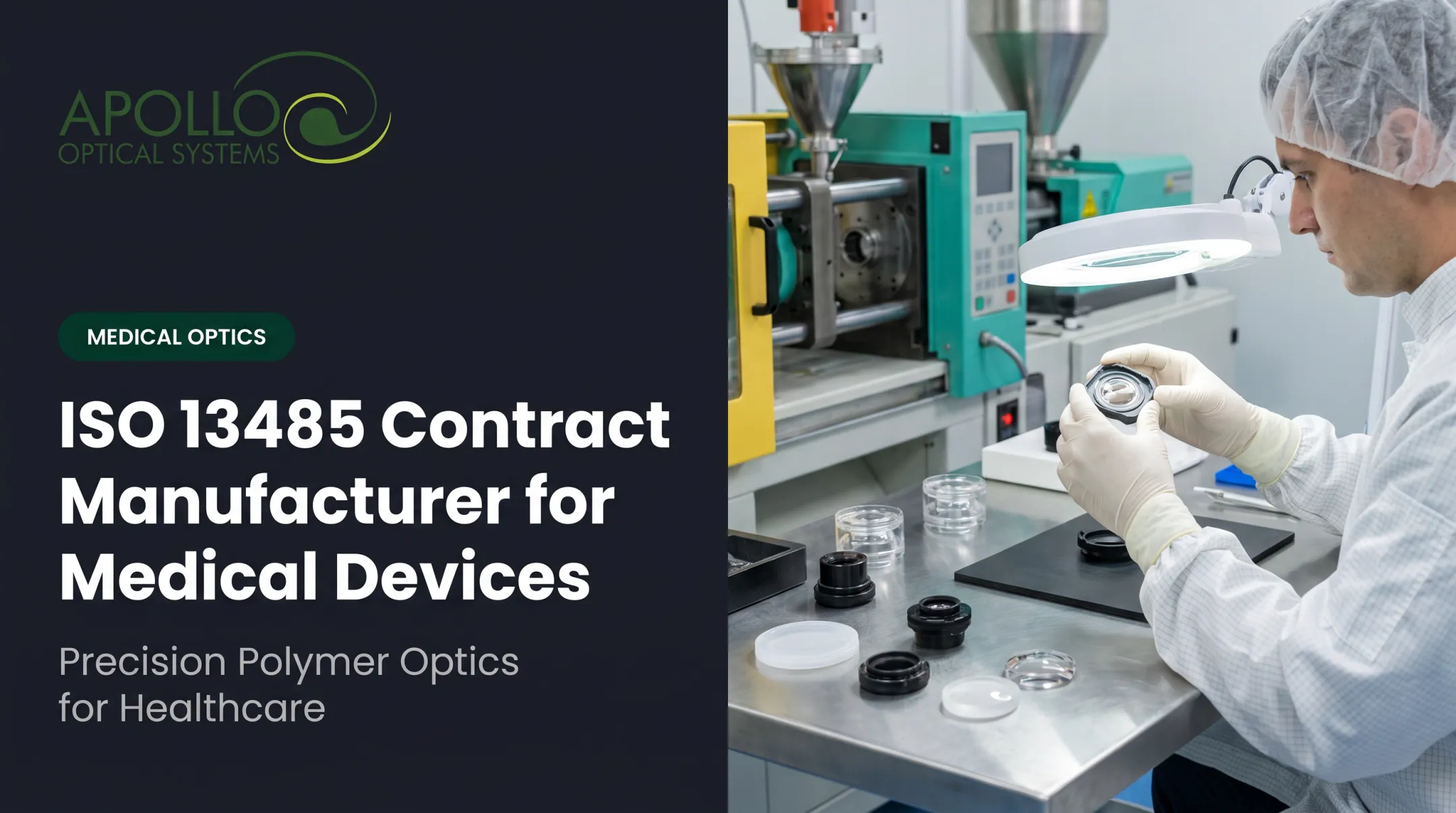
  • Regulatory readiness: ISO 13485-certified manufacturing supporting endoscopes, PPG sensors, and single-use medical optics.

  • True vertical integration: In-house design, molding, coatings, and assembly reduce tolerance risk and supplier complexity.

  • Optical heritage: Founded in Rochester, NY, with deep roots in advanced optical research and manufacturing excellence.

Industries Best Served

  • Medical Devices: Imaging optics, sensors, disposable optical components

  • Defense & Tactical: Ruggedized optical systems and sensing components

  • Automotive & ADAS: Optical elements for LiDAR and sensing systems

2. Jabil Precision Manufacturing (USA)

Jabil Precision Manufacturing operates as a global-scale precision components partner for OEMs requiring high-mix, high-volume production with strict quality and supply chain control.

Jabil integrates advanced machining, molding, and micro-manufacturing within its broader manufacturing ecosystem, making it suitable for programs that demand scalability across regions.

Core Services & Technical Capabilities

  • Precision Machining: CNC machining for tight-tolerance metal and plastic components used in regulated and high-reliability applications.

  • Injection Molding: High-volume molding with process validation and automation for consistent repeatability.

  • Tooling & Industrialization: In-house tooling design, mold validation, and production ramp support.

  • Assembly & Automation: Automated and semi-automated assembly lines for component and sub-system builds.

  • Quality & Compliance: Statistical process control, traceability, and documentation aligned with regulated industries.

Industries Best Served

  • Medical devices & diagnostics

  • Automotive electronics & sensing

  • Industrial equipment & automation

  • Consumer and enterprise electronics

3. Sanmar Group – Precision Engineering Division (India / Global)

https://www.sanmargroup.com/

Sanmar’s precision engineering division focuses on high-accuracy metal and polymer components for OEMs seeking cost-efficient global manufacturing without compromising tolerance control.

The group supports long-term production programs with strong process discipline and export-ready quality systems.

Core Services & Technical Capabilities

  • High-Precision Machining: Multi-axis CNC machining for complex geometries and tight tolerances.

  • Injection & Compression Molding: Engineering-grade polymer components for industrial and automotive use.

  • Surface Treatments: Plating, anodizing, heat treatment, and corrosion-resistant finishes.

  • Tool Design & Maintenance: In-house toolmaking, ensuring lifecycle control and consistent part quality.

  • Quality Systems: Advanced inspection, PPAP, and supplier qualification processes.

Industries Best Served

  • Automotive & EV components

  • Industrial machinery

  • Electrical & power systems

  • General engineering OEMs

4. Amphenol Precision Components (USA / Global)

https://amphenol.com/products

Amphenol Precision Components specializes in ultra-precise interconnect, sensor-adjacent, and electromechanical components for mission-critical systems.

The company operates within tightly controlled manufacturing environments designed for reliability and long product lifecycles.

Core Services & Technical Capabilities

  • Micro & Precision Machining: Tight-tolerance metal components for connectors and sensing assemblies.

  • Advanced Materials: Expertise in copper alloys, stainless steel, and high-performance polymers.

  • High-Volume Production: Automated manufacturing cells for consistent, scalable output.

  • Assembly Integration: Precision assembly for complex electromechanical systems.

  • Testing & Validation: Electrical, mechanical, and environmental testing.

Industries Best Served

  • Aerospace & defense

  • Automotive electronics

  • Industrial sensors & controls

  • Telecommunications infrastructure

5. Phillips Precision Medicraft (USA)

https://www.phillipsmedicraft.com/

Phillips Precision Medicraft is a contract manufacturer built specifically for medical OEMs requiring micron-level precision and regulatory-aligned production.

The company supports device programs from early manufacturability review through sustained commercial production.

Core Services & Technical Capabilities

  • Ultra-Precision Machining: CNC machining for implants, instruments, and device housings.

  • Cleanroom Manufacturing: Controlled environments for sensitive medical components.

  • Injection Molding: Precision polymer components for disposable and reusable devices.

  • Design for Manufacturability: Early-stage DFM support to reduce validation risk.

  • Regulatory Documentation: Full traceability and compliance-ready documentation.

Industries Best Served

  • Medical devices & surgical systems

  • Diagnostic equipment

  • Life sciences instrumentation

6. Micro Technic (Switzerland / Global)

https://micro-technic.com/en/

Micro Technic focuses on micro-precision components for applications where dimensional accuracy directly impacts system performance.

The company is known for its ability to manufacture extremely small, complex parts at scale.

Core Services & Technical Capabilities

  • Micro-Machining: Sub-millimeter machining for intricate mechanical components.

  • Precision Assembly: High-accuracy assembly for micro-mechanical systems.

  • Advanced Metrology: Inline and offline inspection for micron-level tolerances.

  • Material Expertise: Metals and engineering plastics for miniature applications.

  • Process Validation: Stable processes for long-term production consist

Industries Best Served

  • Medical micro-devices

  • Watchmaking & horology

  • Sensors & micro-mechanics

  • Scientific instrumentation

7. Tessy Automation Precision Manufacturing (USA)

https://tessyautomation.com/

Tessy Automation combines precision molding with advanced automation, enabling OEMs to achieve consistent quality at high volumes.

The company emphasizes repeatability, automation-driven efficiency, and lifecycle manufacturing support.

Core Services & Technical Capabilities

  • Precision Injection Molding: High-cavitation tooling and automated molding cells.

  • Automation Engineering: Custom automation for part handling, inspection, and assembly.

  • Tooling & Process Development: Early tooling involvement to ensure scalable outcomes.

  • In-Line Inspection: Vision systems and real-time quality monitoring.

  • Assembly & Packaging: Fully integrated downstream operations.

Industries Best Served

  • Medical disposables & diagnostics

  • Consumer and industrial electronics

  • Automotive components

8. Röchling Industrial Precision Components (Germany / Global)

https://www.roechling.com/automotive/products-solutions/precision-components

Röchling Industrial manufactures high-precision plastic components designed for demanding mechanical, thermal, and chemical environments.

The company supports OEMs requiring engineered plastics at scale with consistent performance.

Core Services & Technical Capabilities

  • Engineering Plastics Processing: Machining and molding of high-performance polymers.

  • Custom Component Design: Application-specific material and geometry optimization.

  • Precision Machining: Tight-tolerance plastic components for industrial use.

  • Global Manufacturing Footprint: Regional production aligned with OEM supply chains.

  • Quality Assurance: Dimensional and functional validation.

Industries Best Served

  • Industrial equipment

  • Automotive & mobility

  • Energy & power systems

  • Heavy engineering

9. Dynacast Precision Components (USA / Global)

https://www.dynacast.com/

Dynacast is a global leader in precision die casting, supporting OEMs with complex metal components produced at scale.

The company is well-suited for programs requiring dimensional stability and high-volume repeatability.

Core Services & Technical Capabilities

  • Precision Die Casting: Zinc, aluminum, and magnesium components.

  • Tool Design & Validation: In-house mold development and lifecycle support.

  • Secondary Operations: Machining, finishing, and surface treatments.

  • Automation & High-Volume Production: Scalable manufacturing systems.

  • Quality & Traceability: Strong inspection and documentation processes.

Industries Best Served

  • Automotive & EV systems

  • Consumer electronics

  • Industrial hardware

10. Trelleborg Precision Engineering (Global)

https://www.trelleborg.com/en/medical/products-capabilities/precision-lsr-tooling

Trelleborg Precision Engineering focuses on engineered polymer components designed for extreme performance conditions.

The company supports OEMs where material behavior and precision directly affect system reliability.

Core Services & Technical Capabilities

  • Precision Polymer Molding: High-performance elastomers and thermoplastics.

  • Application Engineering: Material and geometry optimization for demanding environments.

  • Custom Tooling: Application-specific mold design and validation.

  • Assembly Integration: Component and sub-system builds.

  • Global Supply Support: Manufacturing aligned with multinational OEM needs.

Industries Best Served

  • Aerospace & defense

  • Automotive & mobility

  • Industrial systems

  • Energy & fluid handling

At this point, you’ve seen who the leading players are, but comparing them side by side is where real clarity emerges.

Side-by-Side Comparison of Top Precision Components Manufacturers

Rather than ranking companies generically, the matrix below evaluates them across critical buyer-side criteria that directly impact product performance, risk, and time-to-market.

Company

Core Manufacturing Strength

Design-to-Production Continuity

Regulatory Readiness

Apollo Optical Systems

Polymer optics, microlens arrays, optical assemblies

Full (Design → SPDT → Molding → Assembly)

ISO 13485 (Medical)

Jabil Precision Manufacturing

Machining, molding, and large-scale automation

Partial

Strong

Sanmar Precision Engineering

Metal & polymer machining

Partial

Moderate

Amphenol Precision Components

Micro-machined metal components

Partial

High

Phillips Precision Medicraft

Ultra-precision medical machining

Moderate

Very High

Micro Technic

Micro-scale machining & assembly

Moderate

High

Tessy Automation

High-volume molding + automation

Moderate

High

Röchling Industrial

Engineered plastic machining

Moderate

Moderate

Dynacast

Precision metal die casting

Low

Moderate

Trelleborg Precision

Advanced polymer molding

Moderate

High

Comparison tables clarify capabilities, but real vendor selection happens when you map those capabilities to your exact product risk.

Fit-by-Scenario: Selecting the Right Precision Manufacturing Partner

Fit-by-Scenario: Selecting the Right Precision Manufacturing Partner

Instead of ranking vendors generically, use the framework below to match your product scenario with the manufacturer best equipped to prevent failure, not just deliver parts.

1. Regulated Medical or Imaging Devices

Examples: Endoscopes, PPG sensors, diagnostic imaging components

Medical optical components rarely fail at the concept stage; they fail during scale-up and validation, when polymer behavior, optical tolerances, and documentation must remain stable under ISO 13485 scrutiny.

Best-fit vendors

  • Apollo Optical Systems: End-to-end optical control (design → SPDT → molding → coating → assembly) under ISO 13485, minimizing validation risk for imaging and sensing devices.

  • Phillips Precision Medicraft: Strong choice for medical components where precision machining outweighs optical complexity.

2. If You Need High-Volume Optical Components (ADAS / LiDAR)

Examples: Automotive sensing optics, light management components.

High-volume optical programs fail when designs that work in prototypes cannot hold surface quality, coating uniformity, or optical alignment at scale. In ADAS and LiDAR systems, even small yield losses translate directly into cost overruns and field-performance risk.

Best-fit vendors

  • Apollo Optical Systems: Optics-first polymer molding with production-equivalent SPDT validation and in-house coating control, reducing scale-up risk for automotive sensing optics.

  • Syntec Optics: Suitable for mid-to-high volume optical components where polymer and glass optics are combined.

3. Ultra-Precision Glass Optics

Example: Defense imaging, research-grade optical systems

Glass-based optical systems prioritize surface accuracy and material purity over volume scalability. These programs typically run at lower volumes, where precision consistency and metrology discipline matter more than throughput.

Best-fit vendors

  • Optimax Systems: Industry leader in ultra-precision glass polishing and high-spec optical metrology.

  • Rochester Precision Optics: Strong defense optics heritage with proven low-volume, high-accuracy glass fabrication.

4. Micro-Scale Mechanical Precision

Example: Sub-millimeter components and compact assemblies

At micro scales, tool wear and inspection limits, not design flaws, are the primary causes of failure.

Best-fit vendors

  • Micro Technic: Specialized in sub-millimeter machining with strong micro-assembly capabilities.

  • Amphenol Precision Components: Proven micro-machined metal components for high-reliability systems.

After reviewing the landscape, one pattern is clear: OEMs building optics-driven, regulated, or high-volume systems benefit most from partners that own optical performance end to end, not those that outsource critical steps.

Choose Apollo Optical System as The Precision Components Manufacturing Companies

Apollo Optical Systems is a US-based, optics-first precision manufacturer specializing in polymer optical components and assemblies, built to support OEMs from initial optical design through high-volume production. Unlike general precision suppliers, Apollo’s entire operating model is engineered around optical accuracy, material behavior, and scalable manufacturability.

Apollo Optical system is the best fit for the team that needs: 

  • High-precision optical components with tight tolerance control

  • Regulated medical, defense, or automotive sensing programs

  • A single partner accountable for optical performance end-to-end.

If your product’s success depends on optical accuracy, polymer behavior, and reliable scale-up, Apollo Optical Systems offers the technical depth and manufacturing continuity to reduce risk and accelerate time-to-market.

Talk to Apollo Optical Systems to evaluate your optical design, manufacturability, and scale requirements.

Summing Up

Choosing from the top precision components manufacturing companies is no longer about capacity alone; it’s about technical ownership, process continuity, and risk control. 

As products become more optics-driven, regulated, and performance-sensitive, OEMs must align with manufacturers that can take designs from concept to scaled production without tolerance drift or compliance gaps. 

This guide showed how vendor fit changes by application and why optics-first, vertically integrated partners deliver more predictable outcomes.

If your product depends on optical accuracy, polymer performance, and reliable scale-up, work with a partner built for precision from day one.

Connect with Apollo Optical Systems to assess your design, manufacturability, and production roadmap.

FAQs

1. How early should a precision manufacturer be involved in product design?

Ideally, during concept or early design freeze. Early DFM and tolerance analysis prevent optical distortion, tooling rework, and costly redesigns during scale-up.

2. Are polymer optical components suitable for long-term, mission-critical use?

Yes, when engineered correctly. Optical-grade polymers like Zeonex and Ultem offer excellent thermal stability, impact resistance, and optical clarity for demanding applications.

3. What causes most failures when scaling precision components to high volume?

Mismatch between prototype and production processes. Differences in tooling, materials, or coatings often lead to yield loss and performance drift at scale.

4. How can OEMs verify a supplier’s true precision capability?

Review metrology methods, validation data, and process repeatability—not just tolerance claims. Consistent inspection results matter more than quoted specs.

5. Is it better to work with one integrated supplier or multiple specialists?

For precision and regulated products, a single vertically integrated partner reduces tolerance stack-ups, handoff errors, and overall program risk.