This application note describes multilayer thin-film optical coatings as applied to polymer optical substrates, with a focus on practical performance limits, manufacturability, and qualification considerations.
It is intended for optical, mechanical, and systems engineers evaluating polymers as alternatives to glass in imaging, sensing, illumination, and filtering applications.
This document avoids application-specific guarantees and instead outlines what is physically achievable, what must be validated, and where trade-offs typically occur.
What multilayer optical coatings do (engineering view)

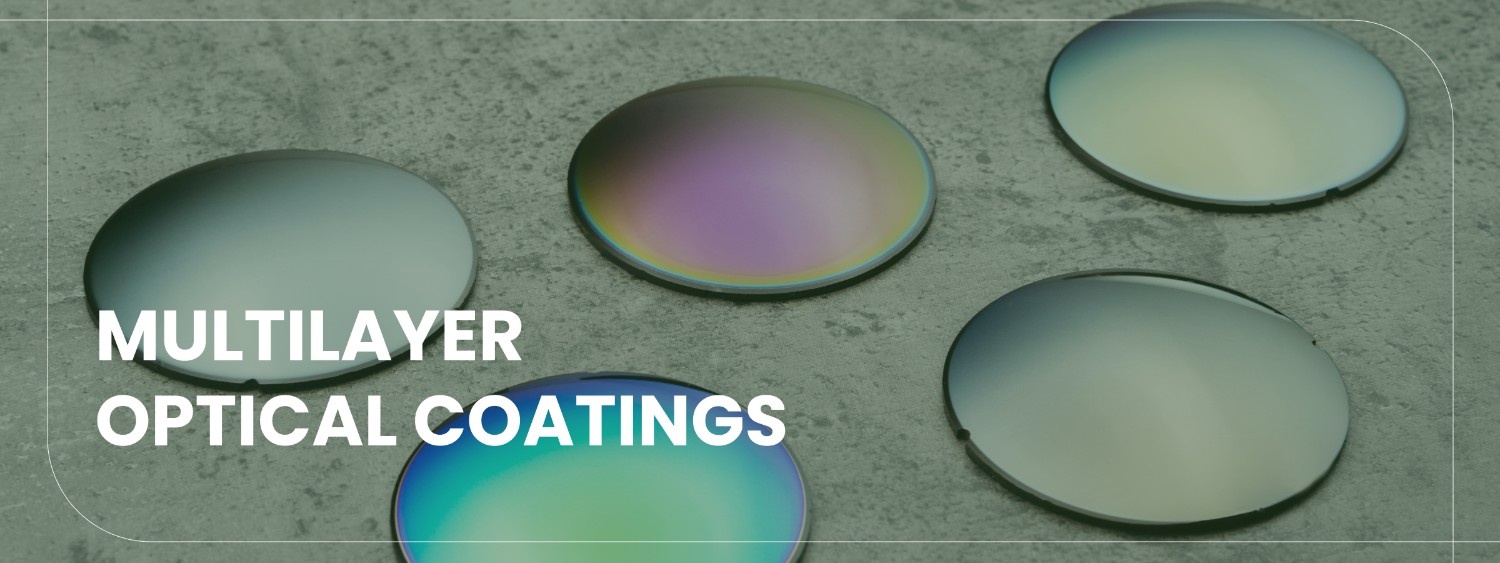
Multilayer optical coatings consist of alternating thin-film layers (typically oxides, fluorides, or nitrides) with thicknesses on the order of tens to hundreds of nanometers.
Performance arises from controlled constructive and destructive interference, allowing designers to tune:
Surface reflectance (anti-reflection, high-reflection)
Spectral transmission or rejection (bandpass, long-pass, short-pass)
Angular response
Polarization sensitivity (where required)
Compared to single-layer coatings, multilayer stacks provide more degrees of freedom, enabling tighter spectral control and higher performance—at the cost of increased process complexity and stress management.
Polymer substrates vs. glass: key implications for coatings
When coatings are applied to polymer optics, several substrate-driven factors must be considered:
Material properties that affect coating behavior
Polymers differ from optical glass in ways that directly impact coating design and durability:
Lower glass-transition temperatures (Tg)
Higher coefficients of thermal expansion (CTE)
Potential moisture absorption (material-dependent)
Lower allowable process temperatures
Different surface chemistries and adhesion mechanisms
These factors do not preclude high-performance coatings, but they require tailored stack design, adhesion layers, and process control.
Coating performance capabilities on polymers

Anti-reflection (AR) performance
Optimized multilayer AR coatings on polymer substrates can achieve sub-1% residual reflectance at a specified wavelength and angle of incidence.
Broadband or wide-angle performance is achievable but requires trade-offs in bandwidth, angle, or minimum reflectance.
Performance must always be specified with:
Wavelength range
Angle of incidence
Polarization (if relevant)
Spectral filters (bandpass, dichroic, edge filters)
Multilayer stacks with dozens of layers are routinely used to implement:
Bandpass filters
Dichroic beam splitters
Edge filters
On polymers, these designs must account for:
Stack stress
Thermal cycling limits
Long-term environmental exposure
High spectral steepness is achievable, but qualification testing is required for durability claims.
Optical throughput and system-level impact
Even small per-surface losses compound in multi-element optical systems.
For example:
A surface with 98% transmission
Across 5–6 coated surfaces
Results in ~9–12% total throughput loss from reflections alone
Multilayer AR coatings are therefore often critical in polymer-based optical systems to preserve signal margin, particularly in low-light or sensing applications.
Mechanical and environmental considerations
Thermal exposure
Polymer-coating survivability under thermal stress depends on:
Substrate material
Coating stack composition
Total film stress
Adhesion layer design
Exposure duration and cycling profile
Certain polymer/coating combinations can be qualified for elevated temperature exposure, including sterilization or thermal cycling, but this must be demonstrated per design.
Statements such as “autoclave-compatible” or “high-temperature stable” are not universal properties of polymer optics and should only be used after validation.
Environmental durability
Coating durability is typically evaluated using standardized tests such as:
Adhesion (tape or cross-hatch)
Abrasion resistance
Humidity and water resistance
Thermal cycling
For optical coatings, ISO 9211 provides commonly referenced durability categories.
Actual service life is application-dependent and should be inferred from qualification testing rather than generalized lifetime claims.
Manufacturing and process constraints
Deposition methods
Multilayer coatings on polymers are typically deposited using:
Low-temperature PVD processes
Electron-beam evaporation with ion assistance
Other temperature-controlled thin-film techniques
Process windows are narrower than for glass and require:
Controlled substrate temperature
Uniform fixturing
Careful rate and stress management
Thickness uniformity
Uniformity on the order of a few percent is achievable in well-controlled coating systems, but results depend on:
Part geometry
Size
Fixturing strategy
Coating architecture
Uniformity targets must be specified and verified per geometry.
Cost considerations
Coating cost is influenced more by:
Stack complexity
Yield
Fixturing
Process time
than by substrate material alone.
In some cases, polymer optics with coatings offer lower total system cost due to:
Reduced optic mass
Integration flexibility
Simplified mechanical assemblies
However, coating cost parity with glass is not universal and must be evaluated case-by-case.
Qualification strategy (recommended)
For polymer optics with multilayer coatings, a defensible qualification approach includes:
Optical performance verification
Transmission / reflection spectra
Angular response
Mechanical and environmental testing
Adhesion
Abrasion
Thermal cycling
Humidity / moisture exposure
Application-specific stress testing
Cleaning protocols
Sterilization (if applicable)
UV exposure (if applicable)
Claims should be tied to test results, not assumed material capability.
Summary
Multilayer optical coatings enable high-performance optical functions on polymer substrates when they are:
Properly designed for polymer material behavior
Deposited using controlled, low-temperature processes
Qualified against real application environments
Polymers offer meaningful advantages in weight, impact resistance, and design flexibility, but coating performance and durability are not automatic. They must be engineered and validated as an integrated system.
When approached correctly, polymer optics with multilayer coatings can meet demanding optical requirements while enabling system-level benefits that are difficult to achieve with glass alone.
Partner with Apollo Optical Systems
Apollo Optical Systems brings decades of optical engineering expertise to polymer optics coating applications. Our Rochester, NY facility combines precision manufacturing with advanced coating capabilities — with process control, qualification support, and scalable production built in from the start.
What we offer:
Coating design tailored for polymer substrates — stack design, adhesion layers, and process parameters matched to your material
Low-temperature deposition processes — controlled process windows for polymer-compatible thin-film deposition
Qualification support — optical, mechanical, and environmental testing aligned to ISO 9211 and application-specific requirements
Prototype to production — seamless transition with identical coating specifications at volume
End-to-end capabilities — design, molding, coating, assembly, and metrology under one roof
Talk to an optical engineer to discuss your coating requirements and qualification approach.
Frequently Asked Questions
Can multilayer coatings achieve the same performance on polymers as on glass?
High-performance coatings are achievable on polymers — including sub-1% AR reflectance and complex spectral filters — but they require stack designs and deposition processes tailored to polymer material behavior. Performance comparable to glass is possible in many applications, but it must be engineered and validated, not assumed.
What deposition methods are used for coating polymer optics?
Low-temperature PVD processes and electron-beam evaporation with ion assistance are most common. These methods allow controlled deposition within the narrow thermal process windows that polymer substrates require, with careful rate and stress management throughout.
How is coating durability validated for polymer optics?
Durability is evaluated through standardized testing including adhesion (tape/cross-hatch), abrasion resistance, humidity and water resistance, and thermal cycling — typically referenced against ISO 9211 categories. Application-specific tests such as sterilization, UV exposure, or cleaning protocol resistance are added based on end-use requirements. Claims should be tied to test results, not inferred from material properties alone.
Are polymer optics with coatings suitable for sterilization environments?
Some polymer/coating combinations can be qualified for sterilization, including elevated temperature and chemical cleaning cycles — but this is design-specific, not a general property of coated polymers. Sterilization compatibility must be demonstrated through testing for the specific substrate, stack, and sterilization method involved.
How does coating uniformity affect performance across a production run?
Thickness uniformity on the order of a few percent is achievable with well-controlled coating systems. Actual results depend on part geometry, size, fixturing strategy, and coating architecture. Uniformity targets must be defined per geometry and verified through metrology — not assumed from equipment capability alone.