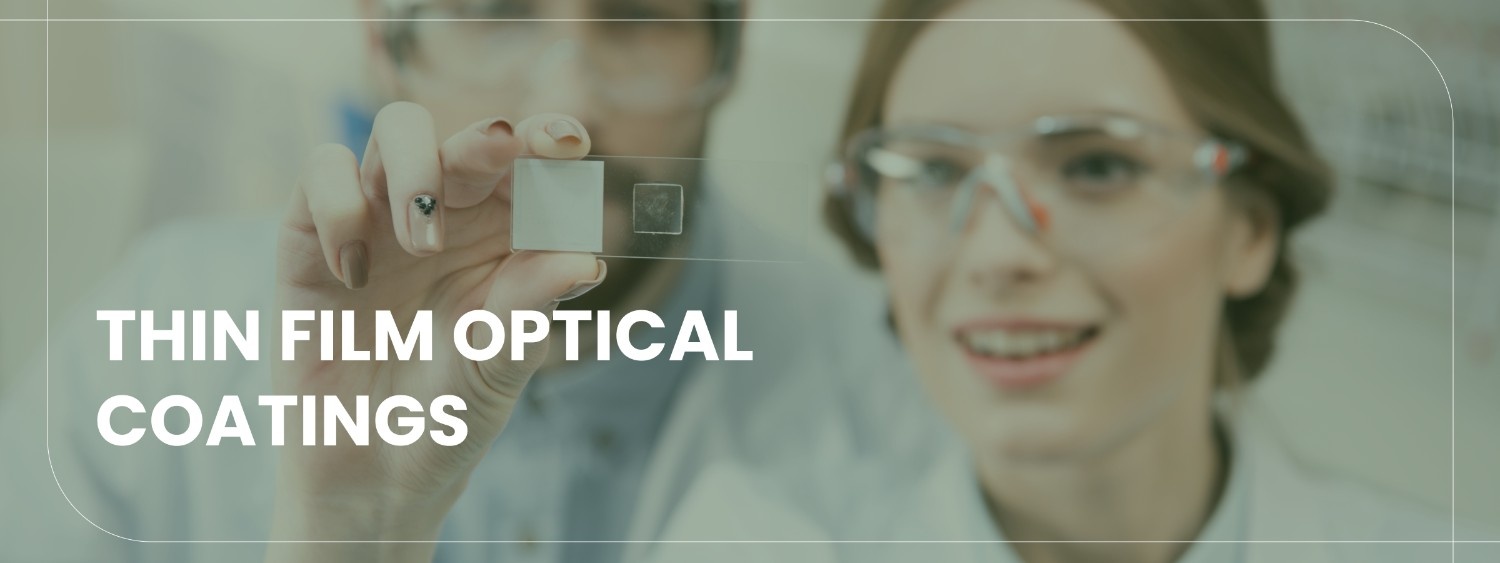
A surgeon leans closer to the monitor, guiding an endoscope through delicate tissue. Every millimeter matters. The image clarity determines precision. Behind that crystal-clear view sits a coating thinner than a human hair, working at the nanometer scale to eliminate glare and maximize light transmission.
This is the silent power of thin film optical coatings.
Whether you design LIDAR systems for autonomous vehicles, develop tactical optics for defense applications, or engineer medical imaging devices, optical coatings directly impact your product's performance. Yet many engineers still rely on outdated surface treatments that limit their optical systems.
This guide breaks down everything you need to know about thin film optical coatings, from basic principles to advanced applications across industries.
Key Takeaways
Thin-film coatings deliver 99%+ light transmission versus ~92% for uncoated optics, boosting overall system performance.
Evaporative and PVD methods enable precise wavelength control, complex multilayers, and durability in harsh environments.
Tailored coatings improve endoscope clarity, extend LIDAR range, and reduce glare in helmet-mounted displays.
Optimal coatings balance wavelength needs, environment, substrate compatibility, volume, and cost.
Apollo Optical Systems offers ISO-certified coating solutions, from prototypes to high-volume production.
What Are Thin Film Optical Coatings?

The challenge with any optical surface is simple: uncoated glass or plastic allows 90% of the visible light spectrum and reflects about 10% of the incoming light, and that loss multiplies across an optical system.
Thin-film optical coatings solve this by depositing ultra-thin layers, typically >170.5 nanometers thick, that use interference effects to precisely control reflection, transmission, and filtering of light.
The coating industry offers several types, each serving specific functions:
Anti-reflective (AR) coatings: Reduce surface reflections and boost light transmission.
Metallic reflective coatings: Create mirrors or reflectors with controlled reflectivity levels
Dichroic filter coatings: Transmit specific wavelengths while reflecting others
Beamsplitter coatings: Divide light into predetermined ratios for imaging or sensing applications
The physics works through constructive and destructive interference. When light waves reflect from multiple thin layers, they interact. Engineers design these layers so reflected waves cancel out while transmitted waves reinforce each other.
This precise engineering transforms optical performance. A properly coated endoscope lens transmits more light to the sensor, producing brighter, clearer images. A coated LIDAR window reduces losses, extending detection range. A helmet-mounted display with AR coatings provides pilots with sharper overlays.
Read on to see how they are transforming optical performance.
How Thin Film Coatings Transform Optical Performance

Traditional optical systems face performance ceilings. Surface polishing alone cannot overcome fundamental reflection losses. Bulk material properties lock you into fixed optical characteristics. You need wavelength control, but have no mechanism to achieve it.
Thin film coatings break through these limitations by delivering multiple performance enhancements:
Enhanced Light Transmission
Uncoated optical surfaces reflect some light per surface due to refractive index mismatches. Multi-element systems quickly accumulate losses. AR coatings reduce reflections, pushing nearly total transmission.
This difference proves critical in light-starved applications. Medical endoscopes need maximum light transmission to illuminate internal body cavities. Automotive cameras must function in low-light conditions. Defense night vision systems depend on capturing every available photon.
Precise Wavelength Control
Different applications require different wavelength responses. Pulse oximeters need coatings optimized for red and infrared light. AR/VR displays demand coatings across the entire visible spectrum.
Multi-layer coating designs achieve this selectivity. Engineers stack different materials in calculated thicknesses to create custom spectral responses. You get exactly the transmission or reflection profile your application demands.
Environmental Protection
Scratch resistance: Hard coating layers protect soft polymer substrates from abrasion
Moisture barriers: Dense films prevent water ingress in humid environments
Temperature stability: Properly selected materials maintain performance from -20°C to +140°C
Chemical resistance: Protective coatings withstand cleaning agents and bodily fluids in medical devices
Common coating materials include magnesium fluoride, silicon dioxide, titanium dioxide, and various metal oxides. Each material brings specific refractive indices and dispersion characteristics to the design. Apollo Optical Systems maintains extensive material libraries and coating recipes developed over decades of production experience.
These performance advantages explain why thin films dominate modern optics. But how do they compare against older approaches?
Why Thin Film Coatings Outperform Traditional Solutions

Traditional optical approaches hit walls that thin film technology easily vaults over. Understanding these differences helps you make informed design decisions.
Aspect | Traditional Optical Design Limitations | Modern Thin-Film Coating Advantages |
Surface control | Relies on surface polishing only; smoothness achieved, but reflections and spectral response remain uncontrolled | Precisely engineered coatings control reflection, transmission, and absorption |
Material dependence | Optical properties fixed by the glass or plastic choice, with no post-manufacturing tunability | Spectral performance tuned through coating design rather than base material |
Wavelength management | No ability to selectively filter, enhance, or suppress specific wavelengths | Custom spectral engineering from UV to infrared |
Functional complexity | Requires multiple thick elements to compensate for optical losses | Multi-layer stacks (50+ layers) deliver complex optical functions in a single element |
Environmental resistance | Exposed surfaces degrade in harsh or demanding environments | Durable protective coatings extend performance in extreme conditions |
Design constraints | Thick, heavy components needed to achieve required optical power | Thin, lightweight designs with equivalent or better optical performance |
System impact | Increased weight, size, and complexity due to added components | Reduced system complexity with fewer, higher-performing elements |
Cost efficiency | Expensive materials chosen to meet performance and durability needs | Cost-effective at scale through high-volume thin-film production |
Material options | Limited to traditional glass-based designs | Enables lightweight, impact-resistant polymer-based optical systems |
Consider a medical imaging system. Traditional uncoated optics might achieve 85% transmission through a 6-element system. That's 15% light loss before reaching the sensor.
Apply broadband AR coatings, and transmission jumps up. You capture more light. That translates directly to brighter images, faster frame rates, or reduced illumination requirements.
The same principles apply across applications. LIDAR systems extend range. Defense optics maintain clarity in extreme conditions. Consumer devices deliver better images in smaller packages.
These advantages matter most when applied to specific industry challenges.
Thin Film Optical Coatings Across Critical Industries

Different industries push optical coatings in different directions. Understanding these applications helps you recognize opportunities in your own designs.
Medical Devices & Life Sciences
The medical device industry has experienced a paradigm shift through magnetron sputtering-enabled thin film coatings that enhance biocompatibility, wear resistance, and osseointegration (bone-implant fusion). Diamond-like carbon coatings, applied via physical vapor deposition (PVD) systems, represent a transformative approach:
Benefit Category | Clinical Impact |
Enhanced Biocompatibility | Less intrusive materials function better in the body |
Improved Wear Resistance | Reduced deterioration within the physiological environment |
Improved Osseointegration | High adhesion success rates through sputtering process optimization |
Reduced Infection Rates | Chemical composition and antibacterial properties prevent bacterial formation |
Companies like DuPont pioneered DLC coatings that maintain flexibility while meeting exacting medical device industry standards.
The magnetron sputtering process enables high-volume manufacturing while achieving precise control over coating thickness and composition, critical for producing implants with consistent osseointegration performance across batches.
Thin film coatings on surgical tools, such as scalpel blades, enhance cutting properties while decreasing post-surgical complications through reduced friction and superior corrosion resistance.
In pharmaceutical applications, controlled drug-release coatings deposited via thin film technology have demonstrated improved drug efficacy, stability, and reduced side effects through precisely engineered multilayer architectures that regulate molecular diffusion rates.
Automotive & LIDAR Systems
Autonomous vehicles depend on optical sensors. LIDAR systems fire laser pulses and measure return times to map surroundings. Every percentage point of transmission loss directly reduces detection range.
Coating applications include:
LIDAR sensor windows: AR coatings at 905nm or 1550nm maximize both outgoing laser power and return signal strength
Driver monitoring systems: Infrared coatings enable cameras to track eye movement and detect drowsiness
Impact-resistant polymer lenses: Hard protective coatings combine with AR layers on lightweight plastic optics
Advanced imaging systems: Multi-spectral coatings support camera fusion for object recognition
Automotive environments prove brutal. Coatings must survive a broad range of temperatures under-hood temperatures. They face stone impacts, car washes, and years of UV exposure. Properly engineered thin films meet these demands.
Tactical & Defense Applications
Military optical systems operate in the harshest conditions imaginable. Desert sand, arctic cold, tropical humidity, and combat shock loads test every component. Mission success often depends on optical performance.
Defense coating requirements include:
Helmet-mounted displays: High-contrast coatings ensure pilots read critical data in bright sunlight while maintaining night vision compatibility
Firearms optics: Durable protective coatings withstand recoil forces and field conditions for years
Thermal imaging systems: Infrared AR coatings maximize sensitivity for target detection
Biometric identification: Multi-band coatings support iris scanning and facial recognition in variable lighting
However, military-grade coatings must pass MIL-STD-810 environmental testing. This includes temperature cycling, humidity, salt fog, and abrasion resistance far exceeding commercial requirements.
Consumer Electronics
Consumer devices drive coating volume. Smartphones alone require billions of coated lenses annually:
AR/VR optical systems: Complex multi-layer coatings enable lightweight headsets with wide fields of view
Smartphone cameras: Broadband AR coatings improve image quality across multiple lens elements
Display protection: Anti-smudge coatings combine with AR layers for better screen visibility
For example, GEOMATEC unveiled g.moth™, a next-generation moth-eye-inspired coating film. Biomimetic engineering replicates nano-scale moth-eye micro-projections onto film surfaces, creating highly water-repellent, anti-smudge coatings that can be safely cleaned with a dry cloth without scratching.
Aerospace & Avionics
Aircraft systems demand reliability at altitude:
Heads-up displays: Beamsplitter coatings project flight data onto windscreens without obscuring visibility
Cockpit instruments: Anti-reflective coatings eliminate glare from sunlight and cockpit lighting
Space-rated optics: Coatings withstand extreme temperature swings and radiation exposure
For example, in next-generation hypersonic aircraft, SiO₂/Al₂O₃ nanocomposite-coated ZnSe domes withstand Mach 5+ heating (800–1,200 °C) while maintaining over 90% infrared transmission across the 1–15 µm band. The 50-nm aluminum-oxide phase forms a corrosion-resistant barrier that cuts surface oxidation by 70% under plasma-rich airflow, as validated in 300-second scramjet test flights.
Industry applications reveal the breadth of coating technology. But how do you specify the right coating for your specific requirements?
How to Select the Right Optical Coating for Your Application

Coating selection determines whether your optical system meets performance requirements. The wrong choice costs money through redesigns and production delays. The right choice optimizes performance while controlling costs.
Start your analysis with these key considerations:
Wavelength Requirements
Define your operating wavelength range precisely
Specify bandwidth needed (narrow-band vs. broadband)
Consider whether you need visible, infrared, or UV optimization
Account for temperature-induced wavelength shifts in laser applications
Environmental Conditions
Operating temperature range affects coating material selection
Humidity exposure determines whether moisture barrier coatings are necessary
Mechanical stress levels guide hardness requirements
Chemical exposure (cleaning agents, solvents) limits material choices
UV exposure affects long-term stability
Substrate Material Compatibility
Polymer substrates dominate modern optical manufacturing due to weight savings and design flexibility. However, polymers pose unique coating challenges.
Temperature limitations: Most polymers cannot withstand high-temperature coating processes
Coefficient of thermal expansion mismatches can cause coating stress
Surface energy differences affect adhesion
Outgassing during deposition can degrade coating quality
Materials like Zeonex, Zeonor, and acrylic offer excellent optical properties for coating. They maintain dimensional stability and surface quality through the coating process.
Production Volume Requirements
Prototype volumes (10 to 100 parts) suit batch coating processes
Medium volumes (1,000 to 10,000 parts) benefit from optimized coating runs
High volumes (100,000+ parts) justify dedicated coating equipment and fixtures
More coating layers improve performance but increase cost. A 3-layer AR coating might achieve 98% transmission at a lower cost. A 7-layer design pushes transmission to 99.5%+ but costs more. Talk to an Apollo Expert to know what suits you.
Start with clear communication about your requirements. The right partner guides you through tradeoffs and suggests optimizations you might not have considered.
Partner with Apollo Optical Systems for Advanced Coating Solutions
Selecting thin-film optical coatings requires hands-on manufacturing expertise. The right partner understands how design, substrates, environments, and scale interact. Polymers need strict temperature control, multilayers demand precise deposition, and scaling adds variability, while multiple vendors often create gaps and quality issues.
Apollo Optical Systems delivers complete optical solutions from design through high-volume production.
We offer:
Collaborative DFM Review: Identify coating challenges early before tooling investment to avoid costly redesigns
Polymer-Optimized Coating Processes: Evaporative coating expertise specifically for temperature-sensitive materials like Zeonex, acrylic, and polycarbonate
Prototype to Production Continuity: Same team, same facility from SPDT prototypes through million-part injection molding runs
Application-Specific Expertise: Proven coating solutions for medical device sterilization cycles, automotive temperature extremes, and defense durability requirements
Single-Point Accountability: Eliminate coordination headaches between optical fabricators, coaters, and assemblers
Facing coating challenges in your optical design? Our engineering team brings over 30 years of polymer optics and thin film coating experience to help you navigate substrate compatibility, environmental requirements, and production scalability. Contact us to discuss your specific application requirements.
FAQs
What is the difference between single-layer and multi-layer optical coatings?
Single-layer coatings deliver ~95–96% transmission at one wavelength and suit narrow-band use. Multi-layer coatings stack films to achieve broadband performance, with 5–7 layers exceeding 99% transmission across the visible range.
How long do optical coatings last in harsh environments?
Well-designed coatings last 10+ years outdoors, meet MIL-STD-810 durability standards, withstand repeated sterilization, and tolerate automotive temperature extremes. Adhesion, materials, and protective layers determine longevity.
Can optical coatings be applied to plastic lenses?
Yes. Modern low-temperature processes coat plastics like polycarbonate and acrylic, offering lighter weight and impact resistance. Success depends on precise surface prep and temperature control.
What causes optical coatings to fail or degrade over time?
Failures stem from poor adhesion, environmental exposure, mechanical abrasion, or thermal stress. However, proper design, materials, and protective layers prevent degradation.