What types of UV optical coatings do you offer?
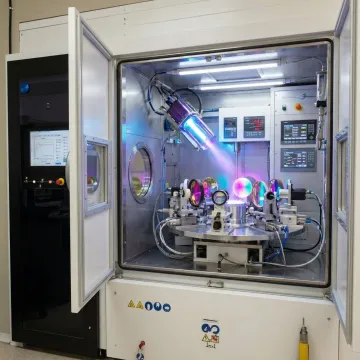
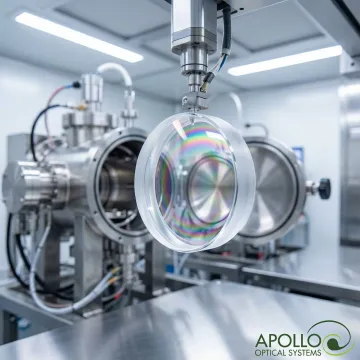
We provide anti-reflective (AR) coatings, evaporative coatings, mirror coatings, and custom thin-film solutions for UV, visible, and NIR wavelength ranges on both polymer and glass substrates. Ultraviolet optical coatings are designed to transmit defined UV wavelengths, block unwanted spectral regions, reduce reflection, and protect optical substrates. UV wavelengths carry higher photon energy than visible light. This changes how materials and coatings behave. Not all optical coatings designed for visible or IR perform reliably in UV.
Can you coat polymer optics with UV-specific requirements?
Yes, we specialize in polymer coating techniques that address the unique temperature limitations and adhesion challenges of plastic optics, ensuring optimal UV performance and durability. UV optical coatings are often optimized for 254 nm (germicidal applications), 365 nm (curing systems), and 405 nm (industrial and medical systems). Performance must account for wavelength-specific absorption, refractive index behavior, angle-of-incidence sensitivity, and environmental exposure. Layer thickness precision directly affects transmission at these wavelengths.
What materials can you apply in your coating processes?
Our coating capabilities include gold, silver, aluminum, magnesium fluoride, and various dielectric materials, applied through advanced evaporation and thin-film deposition techniques. UV transmission depends heavily on substrate material. Glass types may offer stable UV transmission, resistance to solarization, and dimensional stability. Polymer substrates introduce challenges including limited UV transmission depending on material, yellowing or degradation under prolonged UV exposure, thermal expansion mismatch, and potential surface breakdown. Not all polymers are suitable for sustained UV exposure. Material selection must precede coating design.
Do you handle both prototype and production volumes?
Absolutely. We offer flexible production from single prototypes to high-volume batches, with scalable processes designed to meet your specific quantity requirements and timelines. Under sustained UV exposure, some substrates darken, transmission may decrease, coating layers may degrade, and interface stress may increase. UV stability must be validated under realistic exposure conditions. Initial transmission is not sufficient.
What quality standards do you follow for optical coatings?
All coating work is conducted under ISO, FDA, and GMP protocols, with comprehensive in-house metrology capabilities including interferometry and surface analysis to ensure consistent quality. UV systems often generate localized heating, thermal gradients, and repeated on/off cycles. Thin-film stacks must withstand thermal stress, expansion mismatch, and environmental humidity. Adhesion testing should include combined UV and temperature exposure.
How do you ensure coating adhesion on different substrates?
We use substrate-specific preparation techniques and optimized deposition parameters, with extensive testing protocols to validate coating adhesion and performance across various materials. UV coatings rely on nanometer-scale thickness control, uniform deposition across the surface, and stable refractive index behavior. Small deviations can shift transmission peak, reduce efficiency, and alter blocking characteristics. Deposition discipline directly defines spectral accuracy.
What is your typical turnaround time for coating services?
Turnaround times vary based on coating complexity and volume requirements. Contact our team to discuss your specific project timeline and rush order capabilities. When UV coatings are applied to polymer substrates, thermal expansion mismatch increases stress, UV exposure may degrade the base material, and creep under elevated temperature may alter geometry. In some applications, glass provides superior long-term UV stability. Polymer may be suitable in limited UV exposure environments. Material choice must reflect lifecycle demands.
Can you provide coating design consultation services?
Yes, our optical engineers provide comprehensive design consultation, including coating specification development, performance optimization, and manufacturability analysis for your specific application requirements. UV optical systems may face humidity, chemical cleaning, elevated temperature, and mechanical handling. Coating stacks must resist moisture ingress, micro-cracking, and surface degradation. Environmental testing should simulate real operating conditions.
What production-scale realities affect UV coatings?
UV coating performance in prototype builds may not reflect ramp stability. Production challenges can include chamber drift, thickness non-uniformity, contamination, and substrate lot variability. If spectral tolerance is narrow, minor drift affects system performance. Consistent process monitoring is essential.
What should experienced teams evaluate early in UV coating development?
Rather than asking 'Can you apply a UV coating?', experienced teams ask: How stable is UV transmission after prolonged exposure? What solarization data is available? How is thickness uniformity controlled? How does the coating perform under combined UV and thermal cycling? Is the substrate UV-stable over service life? These questions define reliability.