This application note describes optical coatings and thin-film filters, with emphasis on functional behavior, manufacturing constraints, and validation requirements, particularly when implemented on polymer optical substrates.
It is intended for optical and systems engineers designing imaging, sensing, illumination, and spectral-control systems, where filter performance, durability, and repeatability are critical.
This document avoids generic performance claims and focuses on what optical filters can realistically achieve and what must be validated per application.
What optical filters are (engineering definition)

Optical filters control light by selectively transmitting, reflecting, or rejecting specific wavelength ranges.
They are typically implemented as thin-film multilayer coatings, where performance arises from controlled interference effects rather than bulk absorption.
Filter behavior depends on:
Layer materials and refractive index contrast
Layer thickness accuracy
Angle of incidence
Polarization
Substrate interaction
Filters are system-dependent components, not standalone optical guarantees.
Common types of optical filters
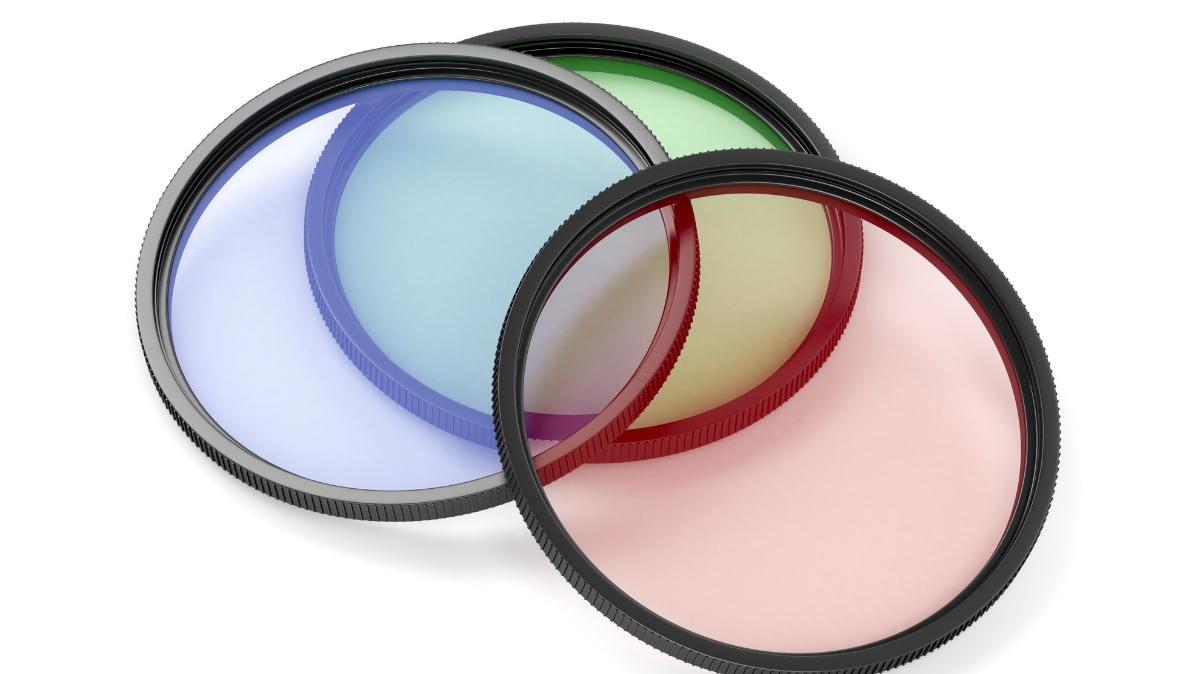
Bandpass filters
Transmit a defined wavelength band while rejecting others.
Performance metrics include:
Center wavelength
Bandwidth
Edge steepness
Out-of-band rejection
Bandpass behavior is sensitive to angle of incidence and polarization.
Long-pass and short-pass filters
Used to block wavelengths below or above a cutoff point.
Cutoff position and steepness depend on:
Stack architecture
Deposition accuracy
Substrate properties
“Sharp” cutoffs require trade-offs in stress, thickness, or angular sensitivity.
Dichroic and reflective filters
Designed to reflect one spectral band while transmitting another.
These filters are commonly angle-dependent and must be specified for:
Design angle
Polarization state
Spectral bandwidth
Polymer substrates and filter behavior

Applying optical filters to polymer substrates introduces additional considerations compared to glass:
Lower allowable deposition temperatures
Higher coefficient of thermal expansion (CTE)
Different surface chemistry and adhesion behavior
Potential moisture sensitivity (material-dependent)
As a result:
Filter stacks must be substrate-specific
Stress management becomes critical
Environmental durability must be validated
Filter performance demonstrated on glass does not automatically transfer to polymers.
Optical performance considerations
Wavelength and angular sensitivity
Thin-film filters are inherently angle-dependent.
As incidence angle changes:
Center wavelength shifts
Bandwidth may broaden
Rejection performance may degrade
Design specifications must clearly define:
Operating angle range
Polarization conditions
Acceptable spectral drift
Transmission and rejection trade-offs
High transmission, steep edges, and high out-of-band rejection cannot all be maximized simultaneously.
Filter design involves balancing:
Optical performance
Stack thickness
Coating stress
Manufacturing yield
Performance claims should always be qualified by design conditions.
Manufacturing considerations
Deposition processes
Optical filters are typically produced using:
Physical vapor deposition (PVD)
Ion-assisted deposition (IAD)
When coating polymers:
Substrate temperature control is critical
Deposition energy must be managed to avoid damage
Fixturing affects uniformity and repeatability
Process windows are narrower than for glass substrates.
Uniformity and part geometry
Filter uniformity depends on:
Part size and shape
Coating architecture
Fixturing strategy
Uniformity specifications must be matched to part geometry, not assumed.
Stress and durability considerations
Filter stacks often contain many layers, increasing the risk of:
Residual stress
Surface deformation
Adhesion loss
Cracking under thermal cycling
On polymer substrates, stress tolerance is lower than on glass.
Low-stress design strategies may require:
Reduced stack thickness
Modified spectral targets
Acceptance of optical trade-offs
Environmental and lifetime behavior
Optical filters should be evaluated under:
Thermal cycling
Humidity exposure (if applicable)
Mechanical stress
Cleaning or handling protocols
Performance over time may differ from initial measurements due to:
Polymer relaxation
Stress redistribution
Environmental exposure
General lifetime claims are not transferable across applications.
Qualification and validation strategy
A defensible optical filter implementation should include:
Optical verification
Spectral transmission and reflection
Angular response
Mechanical and environmental testing
Adhesion
Abrasion
Thermal cycling
Process consistency checks
Lot-to-lot repeatability
Yield tracking
Filter claims must be supported by measured data under representative conditions.
Optical filters as system components
Filters interact with:
Light sources
Detectors
Optical geometry
Mechanical alignment
System-level effects such as:
Stray light
Crosstalk
Thermal drift
must be considered during design.
A “good filter” at the component level may still perform poorly at the system level.
Summary
Optical coatings and filters enable precise spectral control, but their performance is governed by:
Design assumptions
Substrate behavior
Manufacturing limits
Operating environment
When applied to polymer optics, filters require substrate-aware design and validation.
There is no universal filter solution — only application-specific, validated designs.
Key takeaway for engineers
When specifying optical filters:
Define operating conditions clearly
Expect angle and polarization sensitivity
Manage coating stress proactively
Validate performance under real conditions
Optical filters succeed when engineering realism replaces assumption.
How Apollo Optical Systems Supports Optical Filter Coatings That Scale
By the time teams reach this point, the challenge usually isn’t understanding coating theory. It’s making sure the coating survives production, environment, and volume without surprises. That’s where manufacturing experience, not datasheets, makes the difference.
Apollo Optical Systems works with OEM teams at the intersection of optical performance and manufacturability, helping translate coating intent into repeatable, production-ready outcomes, especially on polymer optics.
What Apollo provides across optical filter coating programs:
Early DFM review for coatings and substrates: Identifying adhesion, stress, and durability risks before tooling and validation lock in.
Polymer-focused coating expertise: Experience with optical-grade polymers such as Zeonex, Zeonor, Acrylic, and Ultem, where coating behavior differs fundamentally from glass.
Production-representative prototyping: Using Single Point Diamond Turning (SPDT) to validate optical surfaces and coating assumptions before high-volume injection molding.
In-house coating and finishing capabilities: Evaporative coatings, AR coatings, and custom thin-film solutions aligned with production constraints.
Integrated assembly, metrology, and testing: Verifying that coated components perform as intended once assembled—not just as standalone parts.
Regulated manufacturing readiness: ISO 13485-certified processes supporting medical, automotive sensing, and mission-critical applications.
Rather than treating coatings as a late-stage add-on, Apollo helps teams evaluate them as part of the full optical and manufacturing system.
Connect with Apollo’s optical coating experts to review your coating requirements, substrate choices, and production goals before small assumptions turn into costly redesigns.
Wrapping Up
Most optical programs don’t fail at the design stage; they stall when coatings optical filter assumptions meet production reality for the first time. The teams that avoid that disruption are the ones that pressure-test coating decisions early, against real substrates, real processes, and real volume constraints.
This is where Apollo Optical Systems becomes part of the evaluation, not as a vendor pitch, but as a technical checkpoint.
If coating performance matters beyond first articles, this is the stage where a focused conversation saves the most time and risk.
FAQs
1. When do optical filter coatings become the cost driver in a program, not the optics themselves?
This usually happens when coating yield, rework, or validation failures start to outweigh the cost of the optical component. In coatings optical filter programs, that tipping point often appears during scale-up, not prototyping.
2. How can we tell if our coating requirements are over-specified for production?
Over-specification shows up as narrow process windows, low yield, or coatings that only perform under lab conditions. If meeting the spec requires exceptions or constant tuning, manufacturability may already be compromised.
3. Why do coating issues often appear after environmental or regulatory testing?
Many coating failures are driven by cumulative stress—thermal cycling, humidity, cleaning, or handling, that isn’t fully replicated in early testing. This is common in polymer-based coatings optical filter applications.
4. Can the same optical filter coating be used across multiple products or platforms?
Not always. Differences in substrate material, geometry, or molding variation can change coating behavior, even if the spectral requirement is identical.
5. What information should we have ready before discussing optical filter coatings with a manufacturer?
Beyond wavelength targets, you’ll want clarity on substrate material, production volume, environmental exposure, and validation requirements. These factors often matter more than the coating design itself.