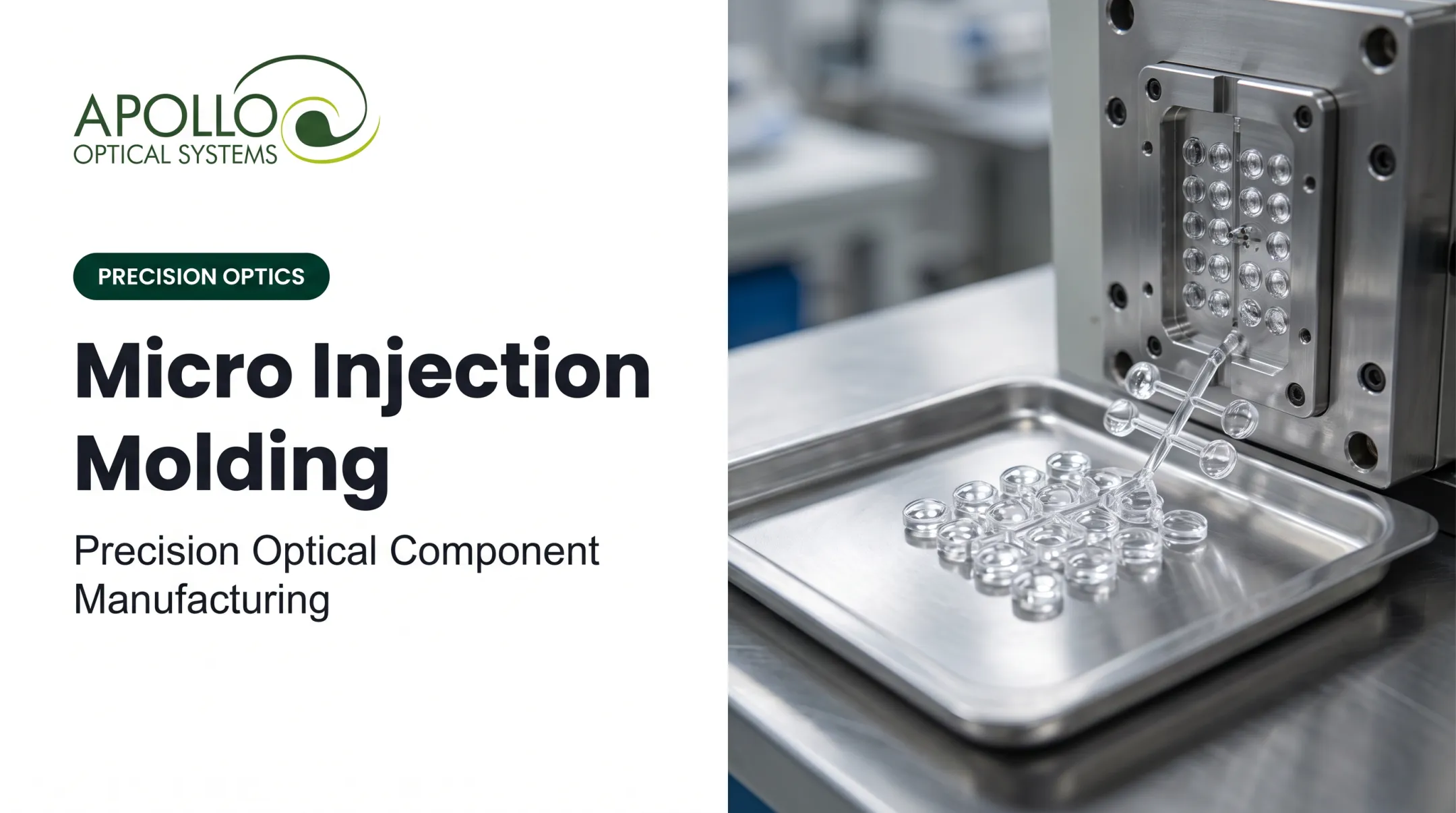

This application note examines precision manufacturing of optical components for small-batch medical device applications, with emphasis on manufacturing control, validation requirements, and scale-transition risks, particularly for polymer optics.
It is intended for optical, mechanical, and medical device engineers working in early-stage development, pilot production, or limited clinical manufacturing, where precision, traceability, and repeatability are critical.
This document avoids implying that small-batch production is inherently easier or less regulated than high-volume manufacturing.
Why small-batch medical optics are uniquely challenging

Small-batch medical optics often exist at the intersection of:
Tight optical performance requirements
Incomplete design freeze
Regulatory and quality system constraints
Limited production volume
Unlike consumer or industrial optics, medical components must satisfy:
Performance requirements
Documentation and traceability requirements
Risk management expectations
Precision must be demonstrated without relying on statistical averaging from high volume.
What “precision” means in small-batch medical optics

In small-batch medical manufacturing, precision encompasses:
Optical surface form and roughness
Dimensional accuracy of critical features
Alignment to defined datums
Part-to-part repeatability across limited runs
Stability over time and environment
Precision must be measured, documented, and repeatable, not assumed.
Polymer optics in medical applications

Polymer optics are often selected for medical devices due to:
Lower mass
Impact resistance
Design flexibility
Replication capability
However, polymers introduce additional considerations:
Higher thermal expansion
Potential moisture sensitivity
Viscoelastic behavior
Sensitivity to process variation
In medical applications, these factors must be controlled within validated manufacturing limits.
Manufacturing considerations for small batches

Tooling strategy
For small-batch production:
Tooling may be prototype or bridge tooling
Tool life may exceed batch size
Tool compensation still matters
Even in limited runs, tooling quality directly impacts:
Optical performance
Repeatability
Transferability to higher volume
Process stability
Small batches do not eliminate the need for:
Stable molding parameters
Controlled environmental conditions
Defined acceptance criteria
Without statistical smoothing from volume, process drift becomes more visible, not less.
Tolerance definition and verification
Medical optics require:
Clearly defined critical tolerances
Separation of cosmetic vs functional requirements
Realistic tolerance allocation based on process capability
Over-specification increases scrap and cost without improving device performance.
Tolerance verification must rely on appropriate metrology, not nominal values.
Metrology and inspection

For small-batch medical optics, inspection strategies often include:
Interferometry or profilometry for optical surfaces
Dimensional inspection of alignment features
Functional optical testing where applicable
Measurement uncertainty must be considered when setting acceptance limits.
Coatings and surface treatments
If coatings are applied:
Coating stress must be managed
Adhesion and durability must be validated
Optical performance must be verified after coating
In medical contexts, coating compatibility with:
Cleaning protocols
Sterilization methods (if applicable)
must be evaluated for the specific material and process.
Regulatory and quality considerations
Small-batch does not mean low-risk.
Manufacturing processes should align with:
Documented work instructions
Change control practices
Traceability requirements
Precision claims should be supported by:
Test records
Inspection data
Process documentation
Even during development or pilot phases, manufacturing decisions can impact future regulatory submissions.
Transition from small-batch to scale
A common failure mode is assuming that:
“If it works at small batch, it will work at scale.”
In reality, scale introduces:
Tool replication
Cavity-to-cavity variation
Process transfer challenges
Small-batch manufacturing should be approached with scale-awareness, even if volume is not immediate.
Summary
Precision manufacturing for small-batch medical optics requires:
Controlled processes
Clear tolerance strategy
Validated performance
Quality-system alignment
Polymer optics can meet demanding medical requirements, but only when manufacturing discipline replaces assumptions.
Small-batch production is not a shortcut — it is a different precision problem.
Key takeaway for engineers
When designing small-batch medical optics:
Define what precision truly matters
Control processes, even at low volume
Validate under real operating conditions
Document decisions with future scale in mind
Precision is not a function of volume — it is a function of engineering rigor.
How Apollo Optical Systems Helps De-Risk Small-Batch Medical Optics
By this stage, most teams aren’t looking for another supplier, they’re looking for certainty. Certainty that what they machine can be measured, validated, assembled, and scaled without reopening decisions they thought were closed.
This is where Apollo Optical Systems supports medical OEMs. Not by selling a process, but by helping small-batch optics behave like a reliable step toward production, not a detour.
How Apollo supports medical optics team at this exact stage:
Precision machining and SPDT under one roof: Enabling small-batch medical optics that reflect production intent, not lab-only builds.
Design-for-manufacturing (DFM) review early in the build cycle: Pressure-testing tolerances, datums, and alignment features before EVT/DVT locks them in.
Polymer and glass optics expertise: Guidance on how material choice affects machining behavior, inspection, coatings, and durability.
Production-representative prototyping: Using SPDT and precision processes to validate optical performance before committing to tooling.
In-house metrology and optical testing: Aligning how parts are made with how they’re verified, so inspection doesn’t become the bottleneck.
ISO 13485–certified manufacturing environment: Supporting medical device programs where traceability and validation matter as much as performance.
For teams navigating small-batch medical optics, Apollo’s role is often to shorten the distance between “this works” and “this is ready to move forward.”
Wrapping Up
The real precision manufacturing small-batch medical optics impact shows up in how confidently teams move through EVT, DVT, and toward scale. When machining, metrology, materials, and validation are aligned early, small batches become a force multiplier instead of a bottleneck. That’s where experienced partners matter.
By supporting precision machining, SPDT prototyping, inspection, and DFM under one roof, Apollo Optical Systems helps teams turn early builds into production-ready decisions.
If your next milestone depends on getting small-batch optics right, connect with Apollo’s medical optics team to validate assumptions before timelines tighten.
FAQs
1. How do we know if small-batch optics are helping or hurting our validation timeline?
If each build generates new questions instead of clear answers, the precision manufacturing small-batch medical optics impact is likely negative, and it’s usually tied to verification or alignment, not machining speed.
2. Why do optics that pass EVT suddenly struggle during DVT builds?
This often happens when early batches didn’t reflect production-level variation, causing hidden assumptions to surface under tighter validation scrutiny.
3. Can tightening tolerances in small batches actually increase risk?
Yes. Over-tight tolerances can create inspection and repeatability issues that slow progress without improving functional performance.
4. What’s the biggest sign we’re using the wrong machining method for our optics?
When teams debate data quality more than design decisions, the method likely isn’t aligned with what the program needs to learn next.
5. How early should regulatory considerations influence small-batch optics builds?
Much earlier than most teams expect. Ignoring them upfront often forces redesigns later, reducing the real precision manufacturing small-batch medical optics impact when timelines matter most.