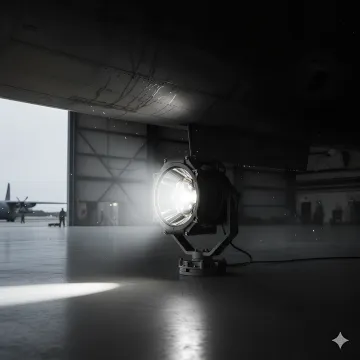
Why are aircraft landing lights considered a serious optical application?
Aircraft landing lights operate in one of the most demanding environments for optical components. They must perform reliably under high vibration and shock, wide temperature swings, exposure to moisture, dust, and debris, continuous thermal cycling, and strict reliability and safety expectations. In aviation, lighting failure is not a cosmetic issue. It is a system reliability issue. As a result, landing light optics must be evaluated as critical components, not commodity lenses or covers.
What are aircraft landing light optics expected to do?
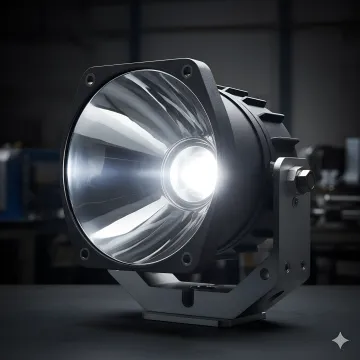
Landing light systems must provide high luminous output and beam control, consistent optical performance over time, resistance to environmental degradation, and predictable behavior under thermal load. Optical elements in these systems often include lenses or beam-shaping optics, protective windows or covers, coated substrates for transmission and durability, and integrated optical housings. Each component contributes directly to performance and safety.
What optical performance considerations are important for landing lights?
For landing light applications, the most important optical factors typically include beam shape and uniformity (light must be directed where it is needed without excessive scatter or glare), transmission efficiency (optical losses translate directly to reduced visibility), and thermal stability (optical behavior must remain stable as components heat during operation and cool afterward). Nominal performance at room temperature is not sufficient.
What environmental and thermal realities affect aircraft landing lights?
Aircraft landing lights experience rapid temperature changes during operation, localized heating from high-power light sources, cold soak at altitude, and vibration during taxi, takeoff, and landing. Optical components must tolerate thermal expansion and contraction, mechanical stress from mounting, and long-term exposure to harsh conditions. Materials and manufacturing methods must be chosen with these realities in mind.
Can polymer components be used in aircraft landing light systems?
Polymers may be used in aircraft landing light optics when weight reduction is important, impact resistance is required, or complex geometries are beneficial. However, polymers introduce higher thermal expansion than glass, sensitivity to sustained heat, and potential long-term dimensional drift. When polymer optics are used, material limits must be clearly defined and validated under representative operating conditions.
What coatings and surface treatments are used on landing light optics?
Landing light optics often require coatings to reduce reflection losses, protect surfaces from abrasion, and improve environmental resistance. Coating performance depends on substrate material, coating stress, thermal compatibility, and environmental exposure. Durability claims must be tied to specific test conditions, not generic descriptors like 'aviation-grade.'
What manufacturing and process control considerations apply to landing light optics?
In aviation applications, repeatability matters as much as performance. Manufacturing considerations include stable tooling and processes, consistent material handling, controlled coating application, and documented inspection and validation. Small variations that might be acceptable in other industries can become reliability risks in aircraft systems.
What qualification and validation expectations apply to landing light optics?
Aircraft landing light optics typically require environmental testing, thermal cycling evaluation, vibration and shock assessment, and performance verification over time. Qualification must reflect actual service conditions, not idealized laboratory setups. Prototype success alone is not sufficient for aviation use.
What are common misconceptions about aircraft landing lights?
Some frequent misunderstandings include assuming brightness equals reliability, treating landing lights as simple illumination optics, and assuming materials used in other lighting applications will translate directly to aviation. Landing light optics sit at the intersection of optics, materials science, and reliability engineering.
How should engineers evaluate landing light optics suppliers?
Rather than asking who 'makes aircraft landing lights,' engineers should ask: What materials are used, and why? How is thermal behavior characterized? What environmental testing has been performed? How is consistency ensured across production? What assumptions are built into the design? Clear answers here are far more valuable than catalog claims.
What is the practical takeaway for aircraft landing light optics?
Aircraft landing light optics must perform consistently under harsh conditions, tolerate mechanical and thermal stress, and maintain optical function over long service lives. These systems succeed when material limits are respected, manufacturing is tightly controlled, and validation reflects real use. That discipline is what aviation reliability demands.
How powerful are aircraft landing lights?
Aircraft landing lights typically range from 600 to 1,600 watts with our compound parabolic reflectors providing optimized high-power beam control for maximum visibility during approach and landing operations.
What are the different types of landing lights?
Landing lights include taxi lights, runway turnoff lights, and wing-mounted landing lights. We manufacture optical components for all types using precision polymer optics and reflector technologies.
What are the landing lights on a plane?
Landing lights are high-intensity white lights mounted on aircraft wings or fuselage to illuminate the runway during takeoff and landing, improving pilot visibility and aircraft conspicuity.
What materials are used in LED aircraft landing lights?
Our aerospace landing light optics use precision polymer materials including PMMA, polycarbonate, and cyclic olefin polymers selected for optical clarity, lightweight construction, and environmental durability.
Can LED landing lights be customized for specific aircraft?
Yes, we provide complete custom optical design services including beam pattern optimization, form factor engineering, and integration with existing aircraft lighting systems for any airframe.
How long do LED aircraft landing lights last?
LED landing lights with our precision optics typically provide 50,000+ hours of operational life, significantly exceeding traditional halogen systems while reducing maintenance costs and aircraft downtime.
What certifications are required for aircraft lighting components?
Aircraft lighting components must meet FAA TSO standards and aerospace quality requirements. We manufacture to ISO 13485 standards and support customers through the certification process.