What types of optical assemblies can Apollo manufacture?
We manufacture a wide range of optical assemblies including UV bonded doublets and triplets, air spaced optical systems, multi-element assemblies up to 34 components, glass/plastic hybrid systems, and refractive/diffractive hybrid systems for medical, aerospace, defense, and industrial applications. Each design respects material behavior and manufacturing limits to ensure production stability.
What materials do you work with for optical components?
We specialize in optical-grade plastics including Acrylic (PMMA), Styrene, Zeonex, Zeonor, and Ultem, as well as metals like Nickel, Brass, Copper, and Aluminum. We also provide coatings for both plastic and glass components. Material selection drives feasibility—polymer offers lightweight integration and complex geometry but introduces shrink variation and thermal expansion, while glass provides dimensional stability and minimal creep for demanding environments.
What is your typical lead time for custom optical assemblies?
Lead times vary based on complexity and volume requirements. We can produce prototypes relatively quickly using our single-point diamond turning capabilities, while production volumes are scheduled based on your specific timeline needs. Production readiness must be evaluated early—custom design must include realistic scale-up strategy accounting for resin lot variation and process window stability.
Do you provide design services or only manufacturing?
We offer comprehensive end-to-end services including optical and mechanical design, design verification, tolerance analysis, design for manufacturing reviews, precision manufacturing, coating, assembly, and metrology testing all under one roof. Tolerance allocation must reflect realistic process capability—overly tight tolerances increase risk and cost without improving system performance.
What quality standards do you follow?
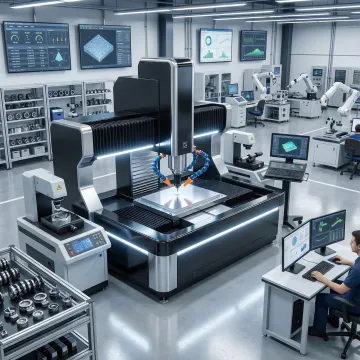
All our work is conducted within ISO, FDA, and GMP protocols. We have extensive in-house metrology capabilities including coordinate measuring systems, interferometry, and specialized optical testing equipment to ensure consistent quality and performance. For polymer optics, we specifically measure internal stress gradients and birefringence that can shift focal geometry and alter beam shape.
What volume capabilities do you have?
We support volumes from one-of-a-kind prototypes to hundreds of thousands of units per month. Our flexible manufacturing approach includes manual setup for prototypes, semi-automatic fixturing for low volume, and full automation for high-volume production. Custom optics often perform well in early builds—we manage ramp challenges including process window narrowing, cooling imbalance, and tool wear through disciplined statistical process control.
Can you handle both optical design and manufacturing?
Yes, having both design and manufacturing capabilities under one roof allows us to optimize designs for production, verify that designs meet performance and budgetary requirements, and ensure manufacturability at scale. An optical design that works in simulation must also work in production—we validate against material behavior and manufacturing limits early.
What coating services do you offer?
We provide anti-reflective (AR) coatings, mirror coatings, filter coatings, beamsplitter coatings, and custom thin-film solutions. All coating fixtures are designed and built in-house, and we specialize in coating polymer optics which require different techniques than glass optics due to thermal expansion compatibility and adhesion requirements.
How does tolerance sensitivity affect custom optics production?
Highly sensitive optical designs can narrow molding process windows, increase scrap rate, require tighter metrology, and increase cost. Tolerance allocation must reflect realistic process capability rather than theoretical perfection. Design for stability—not theoretical perfection—ensures production reliability and cost-effectiveness.
What validation is required for custom optical components?
Injection-molded polymer optics may contain internal stress gradients, birefringence, and localized distortion. Stress can shift focal geometry, alter beam shape, and reduce optical efficiency. Stress management must be part of the design and validation process, not only dimensional inspection. Day-one performance is not sufficient—validation must reflect real operating conditions including temperature cycling and humidity.