What types of custom optical components can you manufacture?
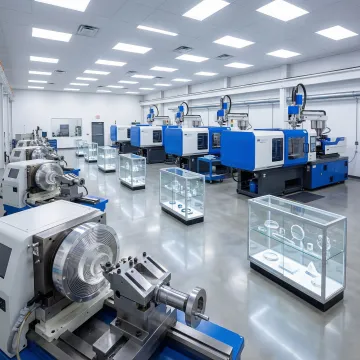
We manufacture a wide range of optical components including aspheric and spherical lenses, diffractive optics, Fresnel lenses, microlens arrays, optical diffusers, prisms, and complex multi-element assemblies using advanced polymer materials and precision manufacturing techniques. Each component maintains geometric precision and surface fidelity through disciplined process control.
What materials do you work with for optical components?
We specialize in optical-grade polymers including Acrylic (PMMA), Polystyrene, Zeonex, Zeonor, and Ultem. We also work with metals like aluminum, brass, copper, and nickel for specialized applications. Material selection is driven by system requirements—polymer provides lightweight integration and complex molded geometry, while glass offers lower thermal expansion and minimal creep for extreme environmental demands.
What is your typical lead time for custom optics projects?
Lead times vary based on project complexity and volume requirements. Prototype development typically takes 2-4 weeks, while production tooling and setup can range from 6-12 weeks. We work closely with clients to meet critical timeline requirements while ensuring process stability and repeatability at scale.
Do you provide optical design services or just manufacturing?
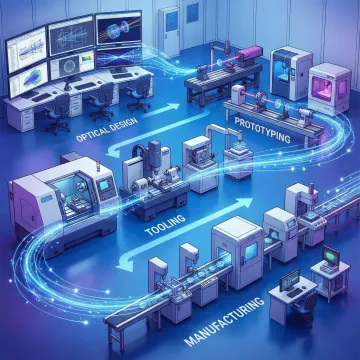
We offer comprehensive services including optical and mechanical design using industry-standard software like ZEMAX®, CODE V®, and SOLIDWORKS®. Our integrated approach ensures designs are optimized for both performance and manufacturability, with realistic tolerance allocation and shrink modeling for polymer components.
What quality standards and testing do you maintain?
We maintain rigorous quality standards with advanced metrology equipment including CMM systems, interferometers, and optical profilers. All work is conducted within ISO, FDA, and GMP protocols with comprehensive documentation and traceability. For polymer optics, we specifically measure and control residual stress and birefringence that can alter refractive behavior.
Can you handle both prototype and high-volume production?
Yes, we support projects from single prototypes to high-volume production runs. Our flexible manufacturing capabilities include manual setup for prototypes, semi-automatic fixturing for low volumes, and full automation for high-volume production. We maintain disciplined statistical process control to ensure optical performance survives scale-up.
What industries do you primarily serve?
We serve diverse industries including Medical & Life Sciences, Defense & Aerospace, Industrial & Commercial Systems, Automotive, Lighting, and Consumer applications, providing specialized optical solutions for each sector's unique requirements including thermal cycling, humidity exposure, and long-term environmental durability.
Do you offer coating services for optical components?
Yes, we provide comprehensive coating services including anti-reflective (AR), mirror, filter, and beamsplitter coatings for UV, visible, and NIR wavelength ranges. All coating fixtures are designed and manufactured in-house for optimal results. Coating performance depends on substrate stability and thermal expansion compatibility, which we validate through lifecycle testing.
How do residual stresses affect injection-molded optical components?
Polymer optics can contain internal stress gradients, birefringence, and localized distortion from the molding process. Residual stress can alter refractive behavior, shift focal geometry, and reduce performance in polarized systems. We measure and control stress through process optimization—not only dimensional inspection.
What production challenges affect optical manufacturing at scale?
Optical programs often perform well in early builds but face challenges during production ramp including resin lot variation, process window narrowing, cooling imbalance, tool wear, and tolerance sensitivity. We address these through shrink modeling, stress management, disciplined statistical process control, and realistic tolerance allocation based on manufacturing capability.