What is optical custom fabrication and what materials can you work with?
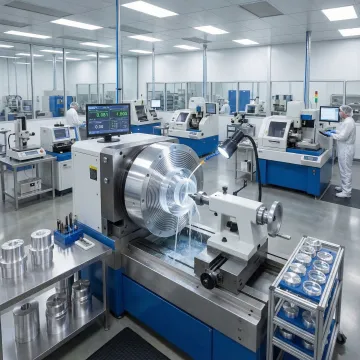
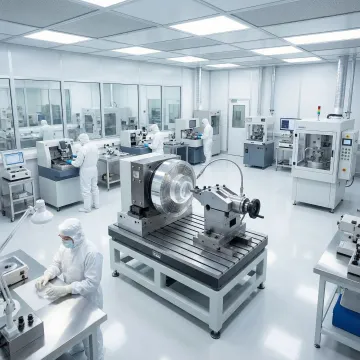
Optical custom fabrication refers to the intentional design and manufacture of optical components where geometry, material choice, and fabrication method are selected to meet specific system requirements. It does not mean unlimited freedom or experimental production. It means optical requirements are clearly defined, fabrication methods are chosen deliberately, material behavior is understood and respected, and performance is validated against real use conditions. Custom fabrication is about alignment, not novelty. We specialize in optical-grade polymers including Acrylic (PMMA), Zeonex, Zeonor, Ultem, and Styrene, as well as metals like Nickel, Brass, Copper, and Aluminum for diamond turning applications.
What size range can you manufacture and when is custom fabrication required?
Our single-point diamond turning capabilities can produce components ranging from 1mm to 300mm in diameter, accommodating both miniature and large aperture optical elements. Custom optical fabrication is typically required when standard catalog optics do not meet system needs, geometry directly affects performance or integration, material choice impacts thermal, mechanical, or optical behavior, and production volumes or environments fall outside commodity solutions. These situations are common in optical, medical, industrial, aerospace, and sensing systems where optics are function-critical.
Do you offer both prototyping and high-volume production and how does geometry affect fabrication?
Yes, we provide flexible manufacturing from one-of-a-kind prototypes to hundreds of thousands of components per month, with appropriate tooling and processes for each volume level. In custom optics, geometry is not aesthetic. It influences wavefront behavior, stray light and scatter, alignment sensitivity, and manufacturability and yield. Effective custom fabrication balances what the optical design requires, what the fabrication process can reliably produce, and what performance must be maintained over time. Ignoring any one of these leads to late-stage redesign.
What surface finish quality can you achieve and what material considerations exist?
We typically achieve 13 Å RMS surface finish in Nickel, 31 Å RMS in Polystyrene, and 60-80 Å RMS with <½ wave peak-to-valley figure in most polymers. Material choice in custom optical fabrication affects transmission and wavelength compatibility, thermal expansion and stability, mechanical robustness, coating compatibility, and lifecycle performance. Glass, polymers, metals, and hybrid substrates each introduce distinct trade-offs. Successful custom optics select materials based on system behavior, not convenience or familiarity.
Do you provide optical design services and what fabrication methods are available?
Absolutely. We offer comprehensive optical and mechanical design services, including design verification, tolerance analysis, and design for manufacturing optimization. Optical custom fabrication may involve precision injection molding, diamond turning, machining or forming, replication processes, and hybrid fabrication approaches. Each method introduces its own surface characteristics, tolerance capabilities, stress profiles, and scalability limits. Choosing the right method is as important as the optical design itself.
What types of optical coatings do you apply and what tolerance considerations exist?
We provide anti-reflective, mirror, filter, and beamsplitter coatings for UV, visible, and NIR ranges on both plastic and glass substrates using advanced thin-film technology. Custom optics can meet tight tolerances — but only when tolerances are functionally justified, surface quality requirements align with the application, and fabrication limits are understood early. Over-specifying tolerances increases cost and risk without improving system performance. Effective custom fabrication focuses on functional tolerances tied to optical sensitivity, not arbitrary targets.
How do you ensure quality and what downstream integration considerations exist?
We maintain extensive in-house metrology capabilities including CMM systems, interferometers, and optical profilers, all operating under ISO, FDA, and GMP protocols. Many custom optical components require reflective or transmissive coatings, environmental protection, and integration with mechanical assemblies. Coatings and integration steps can introduce stress, scatter, and dimensional change. Validation must consider the fully fabricated and finished optic, not just the bare substrate.
What industries do you serve and what lifecycle and scale-up considerations matter?
We serve Medical & Life Sciences, Defense & Aerospace, Industrial & Commercial Systems, Automotive, Lighting, and Consumer electronics industries with precision optical solutions. Custom optical components may experience temperature cycling, vibration or mechanical load, and long service lifetimes. Performance stability over time often matters more than peak performance at initial inspection. Custom fabrication must account for lifecycle behavior, not just first-article results. Custom optical fabrication does not end at prototype success. Reliable programs require processes that scale predictably, tooling and setups that remain stable, and monitoring for drift over time. Many optical failures occur during scale-up, not design. Fabrication methods must support repeatability at volume.
How should engineers approach custom optical fabrication?
Rather than asking 'Can this optic be custom made?', engineers should ask: What fabrication method best supports this geometry? How does material behavior affect performance over time? What tolerances actually matter optically? How will performance be validated after fabrication and coating? Can this process be repeated reliably at scale? Clear answers to these questions define successful custom fabrication.
What is the practical takeaway for optical custom fabrication?
Optical custom fabrication is not about flexibility for its own sake. It is about matching fabrication methods to real requirements, respecting material and process limits, controlling variation, and validating performance under real conditions. When those elements align, custom optics become reliable system components rather than sources of risk.
What are augmented reality optics?
Augmented reality (AR) optics are not a single optical component. They are optical systems designed to inject virtual imagery into a user's field of view, preserve transparency to the real world, maintain alignment, brightness, and color consistency, and remain stable across motion, temperature, and time. AR optics sit at the intersection of optics, materials science, manufacturing, and human perception. Success depends on managing all four simultaneously.
Why are AR optics uniquely challenging?
AR systems impose constraints that rarely coexist elsewhere: extremely tight packaging envelopes, low weight requirements, high optical precision, sensitivity to small alignment errors, and strong dependence on user position and motion. Small deviations that would be irrelevant in conventional optics can become immediately visible in AR systems.
What are common AR optical architectures?
Augmented reality optics may involve elements such as waveguides or light guides, combiners or partially reflective elements, diffractive or holographic structures, beam shaping and pupil expansion features, and integrated polymer or hybrid optical components. Each architecture introduces trade-offs in brightness and efficiency, field of view, color uniformity, and manufacturability and yield. There is no universal AR optical solution — only context-specific compromises.
How does material choice affect AR optics?
Material choice in AR optics affects optical transmission and dispersion, thermal expansion and stability, weight and mechanical compliance, coating compatibility, and long-term environmental behavior. Polymers are often used for weight and integration advantages, but they introduce higher thermal sensitivity, stress-related optical effects, and tighter process windows. Glass offers stability but adds mass and fabrication complexity. Hybrid approaches are common — and difficult.
What manufacturing realities affect AR optics?
AR optics often push manufacturing methods to their limits. Common challenges include tight tolerance stacking across multiple elements, sensitivity to replication fidelity, yield loss due to small defects, and variation that becomes visible only at system level. A design that works optically but cannot be manufactured consistently at scale is not viable. Manufacturing behavior must inform optical design early.
How do coatings affect AR optics performance?
AR optics frequently rely on coatings to manage reflectivity and transmission, control spectral behavior, and enable partial transparency. Coating performance in AR systems is highly sensitive to substrate material, surface finish, coating stress, and angle of incidence. Coatings that perform well in isolation may behave unpredictably once integrated into an AR optical stack.
What alignment and tolerance considerations apply to AR optics?
AR systems are exceptionally sensitive to alignment errors, angular deviations, thickness variation, and thermal movement. Tolerance stacking across multiple optical elements can quickly exceed acceptable limits if not managed intentionally. Functional tolerances must be allocated based on perceptual impact, not just geometric accuracy.
What environmental and lifecycle behavior matters for AR optics?
AR optics must perform under continuous motion, temperature variation, mechanical loading, and long service lifetimes. Performance drift over time — even if subtle — can lead to user discomfort, visual artifacts, or loss of calibration. Lifecycle validation is not optional in AR systems.
What scale-up challenges exist in AR optics?
Many AR optical concepts perform well in prototypes and fail during scale-up. Common scale-up risks include tooling wear affecting optical quality, process drift altering waveguide behavior, coating variation across production lots, and yield loss due to compounded sensitivities. Designs must be evaluated not just for optical feasibility, but for production robustness.
Where do augmented reality optics succeed?
AR optics are most successful when system requirements are clearly prioritized, optical compromises are acknowledged early, material behavior is respected, and manufacturing constraints are treated as design inputs. They fail when optimism replaces discipline.
How should engineers approach AR optics?
Rather than asking 'Can this AR optic be built?', engineers should ask: What optical compromises are acceptable to users? How sensitive is performance to variation? How will this behave at production scale? What materials and coatings are realistic long-term? How will performance be validated over the lifecycle? Clear answers to these questions separate viable AR programs from stalled ones.
What is the practical takeaway for AR optics?
Augmented reality optics are not about chasing ideal optical performance. They are about balancing perception, physics, materials, and manufacturing within extremely tight constraints. Successful AR systems come from realistic optical expectations, material-aware design, disciplined fabrication processes, and validation that reflects real use.