What automotive components can you manufacture?
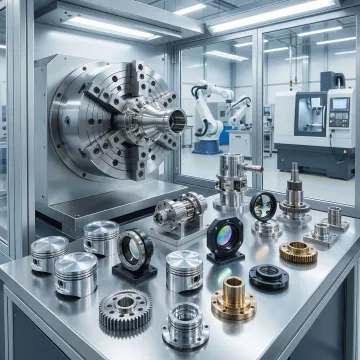
We specialize in precision optical and mechanical automotive components including headlight optics, sensor housings, dashboard displays, camera systems, and complex multi-element assemblies for various automotive applications. A precision automotive components supplier is not defined by tight tolerances alone. It is defined by the ability to produce function-critical parts consistently, maintain performance across millions of cycles, control variation over long production timelines, and support demanding quality and traceability requirements. In automotive programs, precision is measured over time and volume, not at first article.
What precision tolerances can you achieve for automotive parts?
Our single-point diamond turning capabilities achieve surface finishes of 13 Å RMS in metals and 31 Å RMS in polymers, with sub-micron dimensional tolerances suitable for the most demanding automotive applications. Automotive components operate in environments defined by temperature extremes and cycling, vibration and mechanical load, long service lifetimes, and zero tolerance for uncontrolled variation. Small deviations that seem acceptable in other industries can become system-level failures in automotive applications. Precision is about predictability, not perfection.
Do you offer prototype development for automotive components?
Yes, we provide complete prototype development services from initial design consultation through prototype fabrication, testing, and validation before transitioning to production volumes. Precision automotive components may include optical and sensing elements, interior and exterior functional components, structural or alignment-critical features, and integrated polymer or hybrid parts. In many cases, these components directly affect system calibration, sensor accuracy, user safety or compliance, and long-term reliability. That makes manufacturing discipline non-negotiable.
What materials do you work with for automotive applications?
We work with automotive-grade polymers including acrylic, polystyrene, Zeonex, Zeonor, and Ultem, as well as metals including aluminum, brass, copper, and nickel for various automotive component requirements. Material choice in automotive components affects thermal expansion and stability, fatigue and creep behavior, dimensional drift over time, and compatibility with coatings or secondary operations. Polymers, metals, and hybrid materials each introduce distinct risks. Precision suppliers select materials based on how they behave over the full vehicle lifecycle, not just nominal properties.
Can you handle high-volume automotive production?
Yes, our injection molding and assembly capabilities support production volumes from prototypes to hundreds of thousands of parts per month, with scalable manufacturing processes designed for automotive industry demands. Precision automotive manufacturing relies on stable, documented process windows, controlled tooling and equipment, disciplined material handling, and monitoring for drift over time. Inspection alone does not create precision. Precision comes from controlling the variables that drive variation.
What quality certifications do you maintain for automotive work?
We operate under ISO protocols and maintain comprehensive metrology capabilities with advanced measurement systems to ensure all automotive components meet specified requirements and industry standards. Automotive tooling must perform over long production runs, multiple shifts, and extended calendar lifetimes. Tool wear, maintenance practices, and process drift all directly affect part quality. Precision suppliers design tooling and processes with longevity in mind, not just initial capability. Automotive tolerances must be functionally justified, supported by process capability, and stable under real operating conditions. Over-specifying tolerances increases cost and scrap without improving vehicle performance. Under-specifying critical features creates downstream risk. Precision automotive programs allocate tolerances based on system sensitivity, not convention.
Do you provide coating services for automotive optical components?
Yes, we offer advanced optical coatings including anti-reflective, mirror, and filter coatings specifically designed for automotive applications such as headlights, sensors, and display systems. Automotive suppliers are expected to support consistent inspection and verification, material and process traceability, controlled change management, and documentation aligned with customer and regulatory requirements. Uncontrolled change is one of the most common sources of late-stage automotive failures. Precision automotive components must maintain performance through temperature cycling, vibration and shock, environmental exposure, and years of service. Performance stability over time is often more important than peak performance at initial validation. Lifecycle behavior must be considered early in the design and manufacturing process.
What is your typical lead time for automotive component projects?
Lead times vary based on project complexity and volume requirements. We work closely with automotive manufacturers to meet their timeline demands, from rapid prototyping to scheduled production deliveries. Many automotive programs succeed in early builds and struggle during ramp-up. Common risks include process windows that collapse at volume, tooling degradation, and variation amplified by scale. Precision suppliers design processes that hold up under volume, not just in pilot runs.
How should engineers evaluate precision automotive suppliers?
Rather than asking 'Can you hold this tolerance?', engineers ask: How stable is your process over time? How is variation monitored and addressed? How do materials behave over the vehicle lifecycle? How are changes managed once production begins? What happens when something drifts? Clear answers to these questions matter more than marketing claims.
What is the practical takeaway for precision automotive suppliers?
A precision automotive components supplier is defined by repeatability, not hero parts; controlled processes, not inspection volume; lifecycle thinking, not short-term success. Precision is earned through discipline, not promised.
What does Apollo Optical Systems actually do?
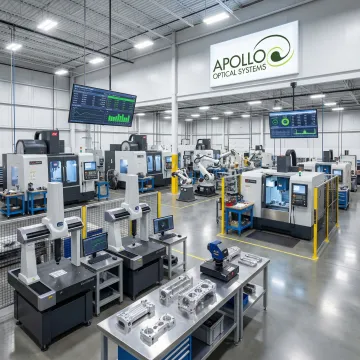
Apollo Optical Systems is an engineering-driven manufacturer of optical and opto-mechanical components for applications where performance must be repeatable, scalable, and stable over time. We do not position optics as isolated parts. We treat them as manufactured system elements, shaped by material behavior, fabrication limits, and lifecycle constraints. That perspective guides how we design, fabricate, and validate everything we produce.
What is Apollo Optical Systems' operating philosophy?
Optical performance does not fail in theory. It fails in production. Most late-stage problems come from material behavior that was underestimated, tolerances that were specified without sensitivity analysis, fabrication methods chosen too late, and coatings treated as finishes instead of system elements. Apollo Optical Systems works from the opposite direction: manufacturing reality informs design from the start.
What does Apollo Optical Systems focus on?
Our work centers on optical programs where geometry directly affects system performance, materials behave differently over time and environment, tolerances must hold at volume not just at prototype, and coatings and fabrication steps interact in non-obvious ways. These conditions are common in automotive, medical, industrial, sensing, infrared, and emerging technology applications.
How does Apollo Optical Systems approach materials and fabrication?
We treat materials as behavior models, not catalog choices. Depending on the application, this may include optical polymers and precision injection molding, glass and hybrid substrates, diamond-turned and replicated surfaces, and thin-film and specialty coatings. Each material and method introduces trade-offs in thermal stability, stress response, surface behavior, and manufacturability and yield. Our role is to make those trade-offs explicit and design around them intentionally.
What is Apollo's manufacturing discipline?
We do not optimize for one-off performance. We optimize for repeatability over time, stability across production volume, controlled variation, and predictable lifecycle behavior. Inspection detects defects. Process control prevents them. That distinction matters in real programs.
How does Apollo approach tolerances and surfaces?
Tight tolerances only matter when they affect function. Apollo Optical Systems emphasizes functional tolerance allocation, surface requirements tied to optical sensitivity, and avoidance of over-specification that increases risk without benefit. Precision is not about making everything tight. It is about making the right things stable.
How does Apollo treat coatings in optical systems?
Coatings are not finishes. They are functional layers that interact with substrate material, surface morphology, thermal expansion, and environmental exposure. We treat coating selection, stack design, and validation as part of the optical system — not as a downstream step.
What validation approach does Apollo use?
Initial inspection does not predict long-term success. Our programs consider temperature cycling, mechanical stress, environmental exposure, and process drift over time. Performance that cannot be validated across the expected lifecycle is not considered complete.
Where does Apollo Optical Systems fit best?
Apollo Optical Systems is a strong fit when performance margins are tight, scale-up risk must be managed early, material behavior matters, and manufacturing realism is required. We are not optimized for commodity optics or speculative designs disconnected from production.
How do engineering teams work with Apollo?
Teams typically engage Apollo Optical Systems when they want to answer questions like: What fabrication method actually supports this geometry? How will this material behave over time and temperature? Which tolerances truly matter? What will change when we scale? Where are the hidden risks? Clear answers early prevent expensive problems later.
What is the practical takeaway about Apollo Optical Systems?
Apollo Optical Systems exists to close the gap between optical theory, material behavior, manufacturing limits, and real-world performance. That gap is where most optical programs fail. We operate in that gap deliberately.