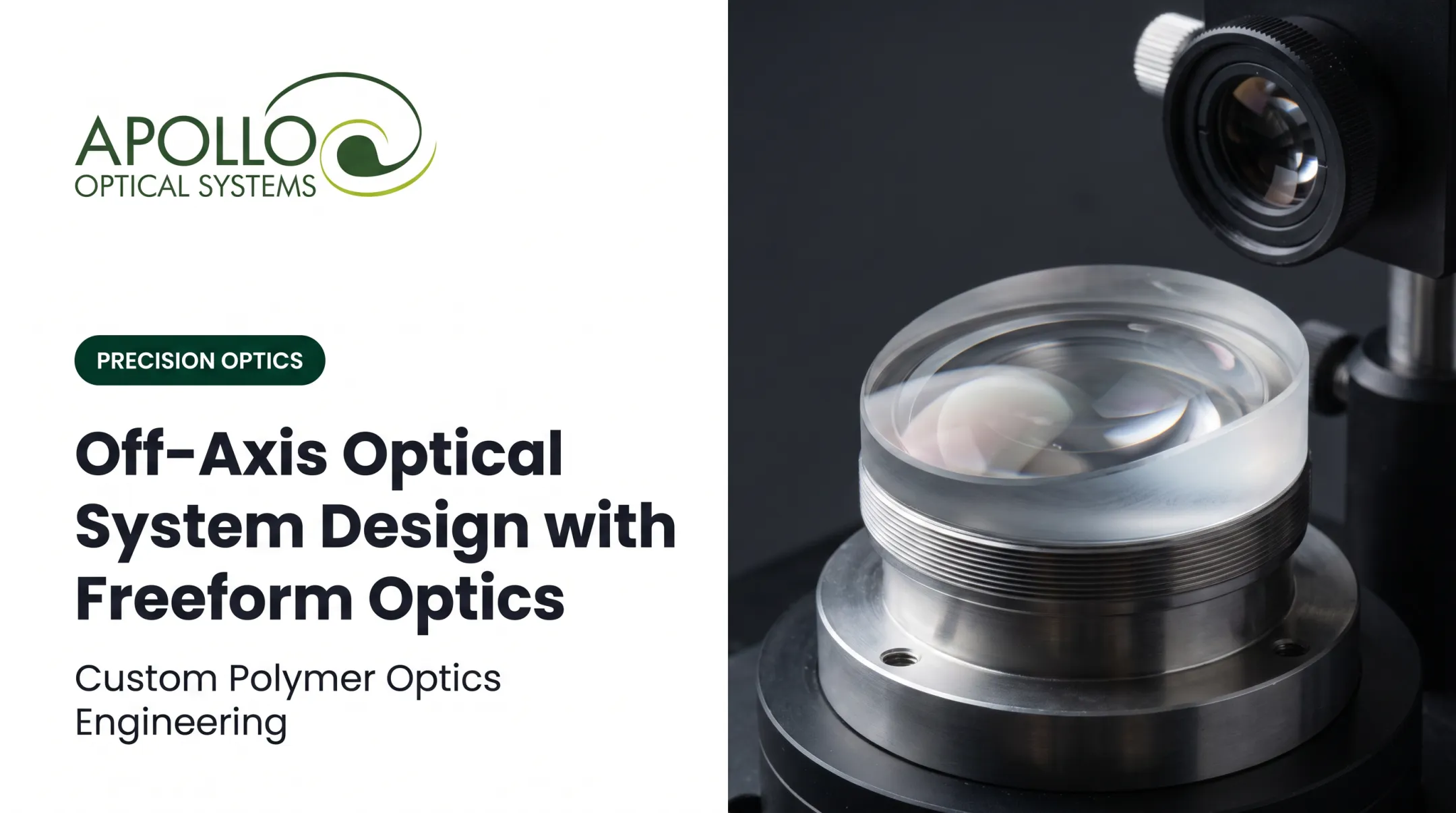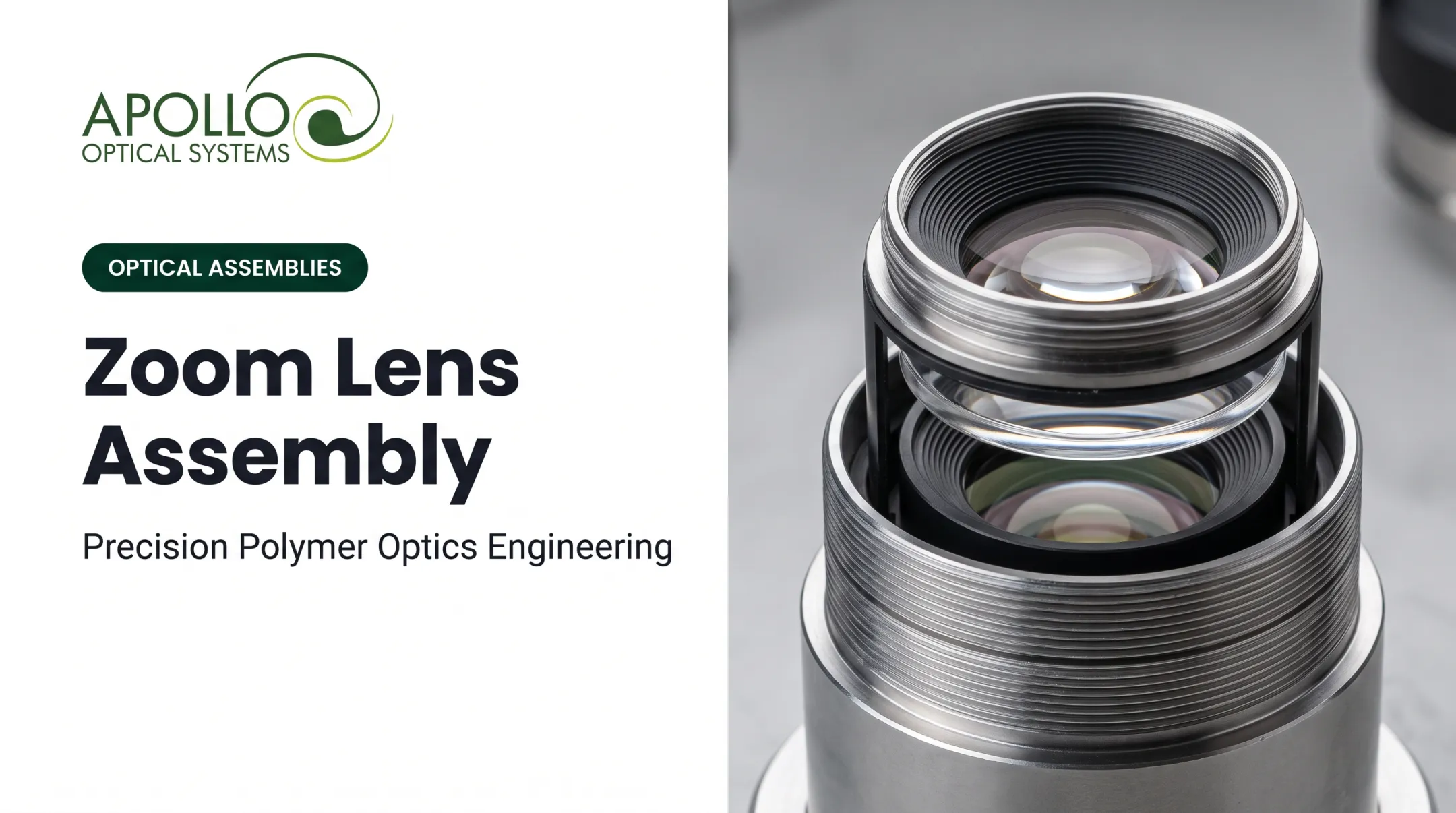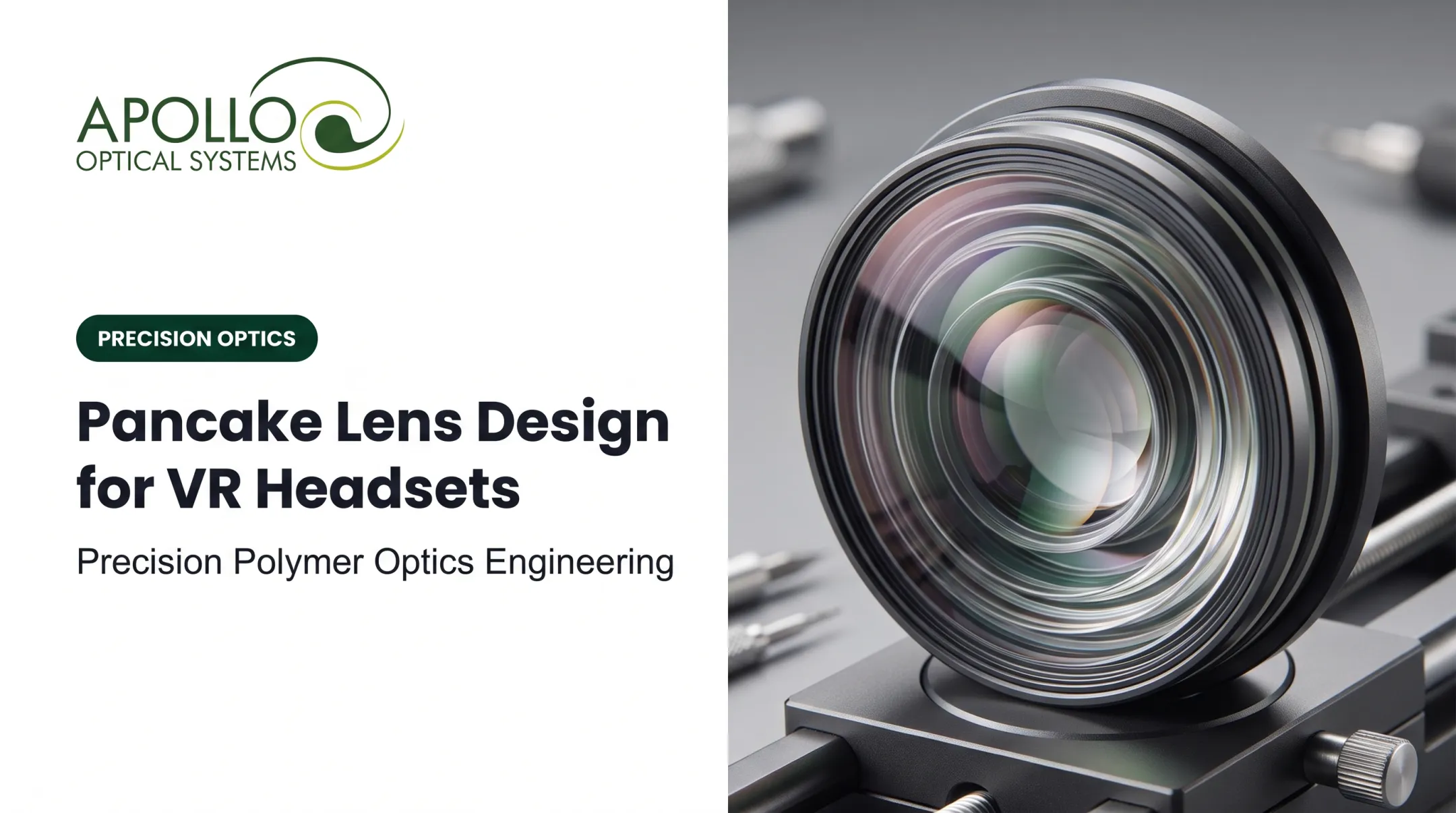

That shift matters far beyond the optics lab. Freeform lenses now show up in defense sighting systems, medical endoscopes, automotive headlights, and the AR/VR headset on someone's desk. This guide breaks down what freeform lenses actually are, how they differ from conventional optics, where they're deployed, how they get manufactured, and what to look for in a manufacturing partner.
Key Takeaways
- Freeform surfaces correct aberrations impossible to fix with spherical or aspheric designs alone
- Enable compact, high-performance systems in defense sensors, medical imaging, automotive lighting, and AR/VR headsets
- Prototype with diamond turning, then scale cost-effectively through injection molding
- Expect 5x to 20x higher cost versus a comparable spherical optic
- A design-through-production partner cuts handoff errors and specification risk
What Are Freeform Lenses?
A freeform lens has a surface that lacks translational or rotational symmetry, meaning it doesn't look the same when rotated around an axis. Unlike a sphere or asphere, which can be described with a handful of simple parameters, a freeform surface is shaped point-by-point using advanced computer algorithms, according to the Center for Freeform Optics.
Surface complexity scales in three steps:
- Spherical surfaces — simplest to make, but limited correction ability
- Aspheric surfaces — rotationally symmetric, better aberration control, still constrained
- Freeform surfaces — no symmetry constraint, correct aberrations that vary across the field
Common Surface Types
Optical designers choose from several mathematical representations depending on system requirements:
- XY polynomials — flexible, widely used, but not orthogonal
- Zernike polynomials — orthogonal basis, useful for separating surface terms
- Chebyshev polynomials — orthogonal over a normalized square aperture
- Q-type (Forbes) polynomials — orthogonal in gradient, favored when slope and manufacturability matter

Every freeform design gets modeled and validated in optical simulation software before anyone cuts metal or fills a mold. Gaps in that simulation-to-fabrication handoff are a common source of scrap and schedule slip—covered in the manufacturing section.
Note: "freeform lens" in eyewear usually refers to progressive lens surfacing, ground digitally on the back of the lens. That's a different world from the industrial, defense, and medical freeform optics this guide focuses on.
How Freeform Lenses Differ from Conventional and Aspheric Lenses
Spherical and aspheric lenses are rotationally symmetric. Whatever correction happens at one point on the edge happens identically all the way around. Freeform surfaces break that rule entirely, allowing independent correction at every point.
That difference shows up clearly in design:
| Property | Spherical / Aspheric | Freeform |
|---|---|---|
| Symmetry | Rotationally symmetric | No required rotational symmetry |
| Correction | Same at every point around the edge | Independent at every surface point |
| System role | Often needs multiple elements | One element can replace two or three |
According to the 2021 Optica review of freeform optics for imaging, a single freeform surface can take on work that once required several conventional lenses or mirrors.
Real-world example: A 2021 automotive study built an asymmetric double-freeform lens that produced both low and high headlight beams from a single element, in a housing measuring just 91 x 64 x 64 mm. The system met ECE regulatory requirements in testing.
But there's a cost trade-off. Freeform manufacturing can run 5x, 7x, or up to 20x the cost of a comparable spherical optic, according to a 2023 Photonics Spectra analysis of freeform manufacturing methods. System-level performance often justifies that premium, but not always. Compare total system cost, not lens-to-lens pricing.

Key Applications of Freeform Lenses Across Industries
Defense & Aerospace
Freeform optics let engineers shrink multi-mirror telescope designs without giving up field of view or resolution. A 2022 study demonstrated a two-mirror freeform telescope with a 120-degree field of view and 2.6-km spatial resolution in a package small enough for a single CubeSat unit.
Beyond space imaging, freeform surfaces also show up in:
- Sighting systems and night-vision devices
- Compact sensor and surveillance optics
- Guidance systems with lower part counts
Medical & Life Sciences
Compact, high-fidelity optics matter most where space is tightest—inside an endoscope, for example. A 2023 report described an adjustable-focus endoscope using two polymer plates, each pairing a flat surface with a freeform curve, to manage focus in a constrained package.
Typical medical uses include:
- Endoscopic and minimally invasive imaging
- Diagnostic and lab instrumentation
- Wearable and point-of-care optical modules
Automotive
Two applications dominate automotive freeform work:
- Headlight beam shaping: freeform lenses redistribute LED output into precise patterns that limit glare for oncoming drivers while maximizing road coverage
- Heads-up displays: freeform mirrors and lenses fold the optical path into the tight envelope of a dashboard
Consumer Electronics & AR/VR
Freeform prisms let designers fold refraction, total internal reflection, and mirror-like reflection into one compact element. A 2022 Frontiers review of AR near-eye displays notes this combination reduces headset form factor while supporting a wide field of view, though fixed-power freeform combiners still face accommodation-related trade-offs.
Industrial & Lighting
Freeform elements reshape light from LEDs or lasers into controlled target patterns. Common uses include:
- Signage and architectural illumination
- Machine-vision and sensor lighting
- Specialty beam control for industrial processes
Across these industries, Apollo Optical Systems builds custom polymer freeform optics around each customer’s performance, packaging, and volume requirements.

How Freeform Lenses Are Manufactured
Single-Point Diamond Turning
Single-point diamond turning (SPDT) is the primary method for cutting freeform geometry into polymer or metal substrates. A diamond-tipped tool, guided by computer control, removes material with sub-micron precision.
SPDT is the go-to for:
- Prototypes and design validation
- Mold inserts for later injection molding
- Low-volume production runs
Polymer Injection Molding
For volume production, diamond-turned mold inserts are used in polymer injection molding. Once the mold is qualified, this route reproduces complex freeform geometry across thousands of cycles. It is the scalable path from prototype to production quantities.
Metrology and Interferometry
Verifying a freeform surface is harder than measuring a sphere. Because freeform surfaces have no rotational symmetry, measurement requires reference datums and coordinate systems that stay consistent throughout manufacturing. A 2019 study on design-for-metrology in freeform optics manufacturing outlines this requirement.
Simulated designs are idealized. Real fabrication introduces process variation, so tolerance budgets need to account for actual machine and material behavior, not just the nominal polynomial.
Apollo's Rochester, NY facility reflects this end-to-end approach:
- Single-point diamond turning (three lathes, including two Precitech Nanoform 200 machines)
- Polymer injection molding and assembly lines
- Precision machine shop
- In-house metrology, including a Zeiss Contura G2 CMM and Zygo interferometers
Typical results run 60–80 Å RMS surface finish in polymers and 30–50 Å RMS in metals.

Are Freeform Lenses Worth It? Benefits and Considerations
Core benefits:
- Improved optical performance across the full field
- Reduced component count (fewer lenses, mirrors, or reflectors)
- Smaller, lighter optical systems
- Correction of aberrations that symmetric optics cannot address
Trade-offs to weigh:
- Higher upfront design and tooling investment
- Specialized manufacturing and metrology expertise
- Longer development cycles for first-time freeform programs
Whether freeform is worth the investment depends on what the application demands. In a compact HUD or CubeSat telescope, freeform is often the only practical path to the size and performance target. For less space-constrained systems, a well-designed aspheric solution may still be the more economical choice.

Choosing the Right Freeform Optics Manufacturing Partner
Freeform programs fail most often at the handoffs, between design and prototyping, or between prototyping and volume production. A partner who owns the full workflow removes those failure points. Look for:
- End-to-end capability: design support, prototyping, and scalable manufacturing under one roof
- Polymer freeform expertise: proven work in tight-tolerance defense, medical, and automotive programs
- In-house metrology: surface verification matched to the freeform prescription, not spherical-only tools
- Secure domestic supply chain: fewer external dependencies and tighter control of schedule and quality Apollo Optical Systems carries optical heritage from Rochester Photonics Corporation, a 1989 spin-off from the University of Rochester's Institute of Optics. Formed in 2002 through a management buyout, Apollo now runs a 21,000-square-foot facility in Rochester, NY. That site brings diamond turning, polymer injection molding, a precision machine shop, coating, and metrology together—so programs work with one U.S.-based partner from concept through scale.
Frequently Asked Questions
Are freeform lenses worth it?
For compact, high-performance, or aberration-sensitive systems—HUDs, satellite telescopes, and similar designs—freeform optics are often essential rather than optional. Value depends on whether your system needs that level of correction and packaging.
What are freeform lenses?
Freeform lenses have non-spherical, non-rotationally symmetric surfaces designed using computer algorithms. This lets each point on the surface be shaped independently for tailored optical performance.
What is a freeform progressive lens?
In eyewear, this means a progressive prescription that is digitally surfaced onto the back of the lens. It typically delivers wider fields of clear vision than older progressive designs.
What are digital freeform lenses?
"Digital" refers to computer-controlled diamond turning used to fabricate freeform surfaces. That process reaches sub-micron precision traditional grinding methods can't match.
What industries rely most on freeform optics?
Defense, medical devices, automotive, and consumer electronics are the primary industries driving freeform optics adoption, each using the technology to shrink optical systems while improving performance.
How are freeform optics manufactured at scale?
Diamond turning handles prototypes and low-volume production, while polymer injection molding using diamond-turned mold inserts provides the scalable path for high-volume manufacturing.