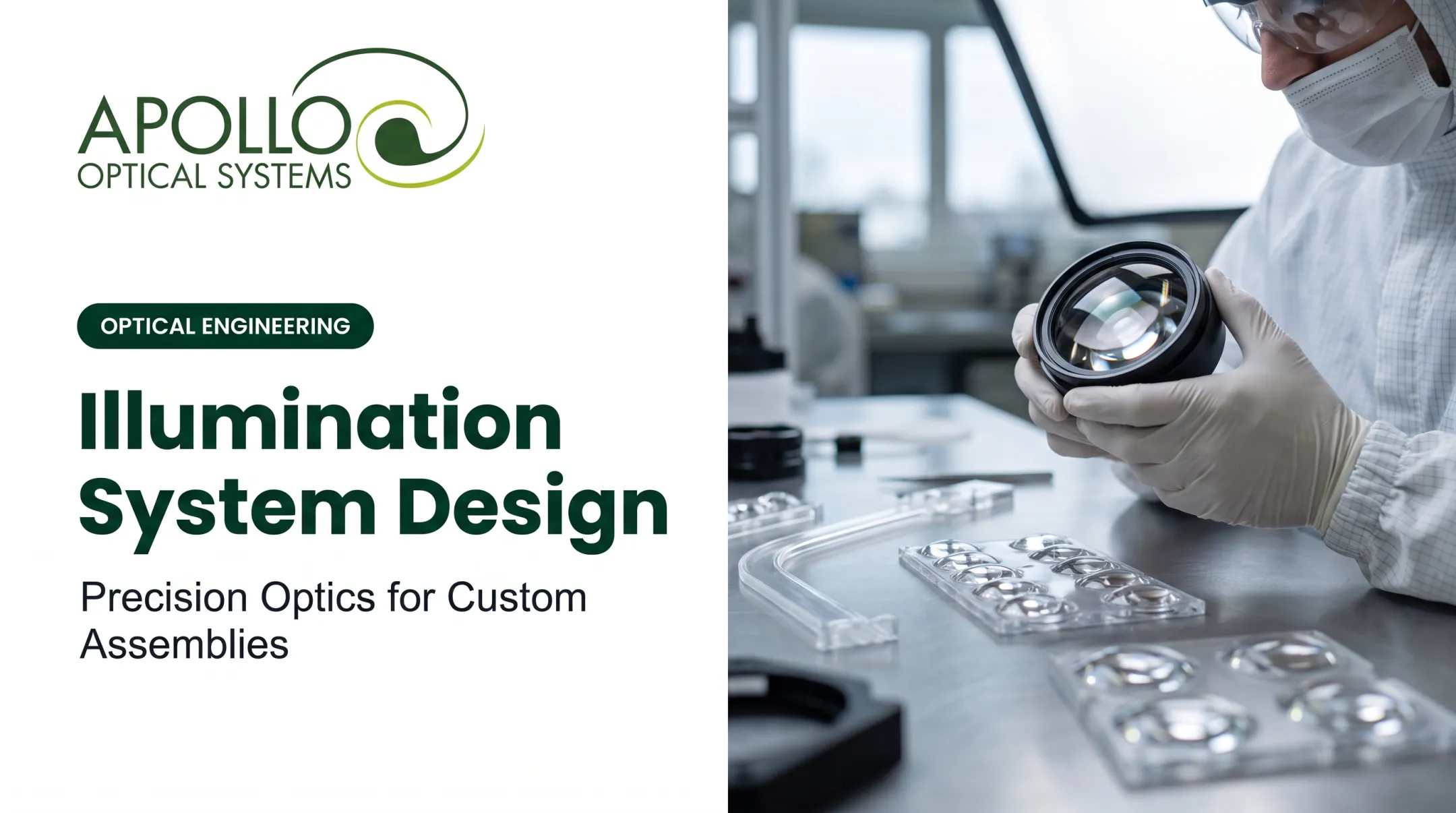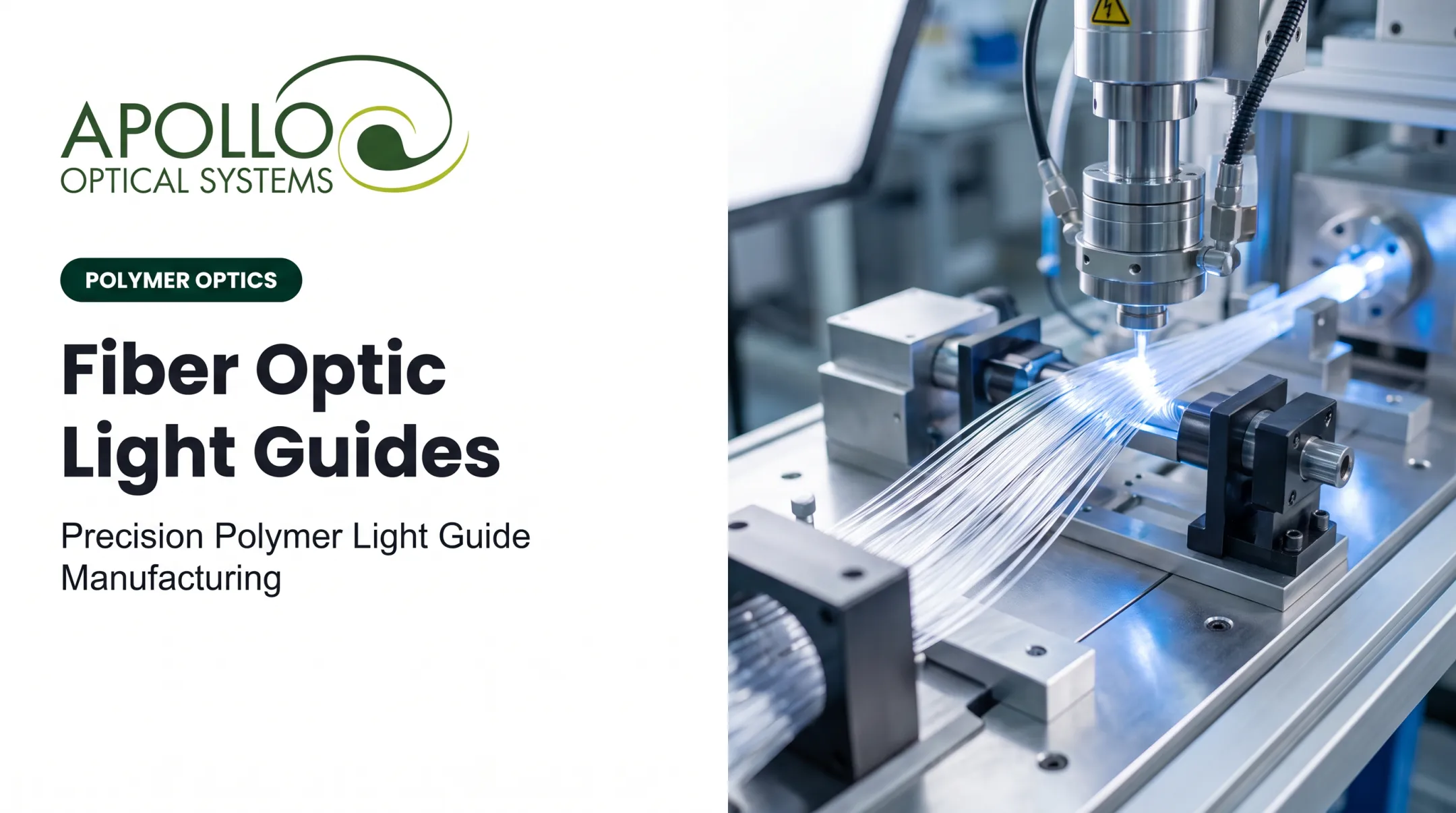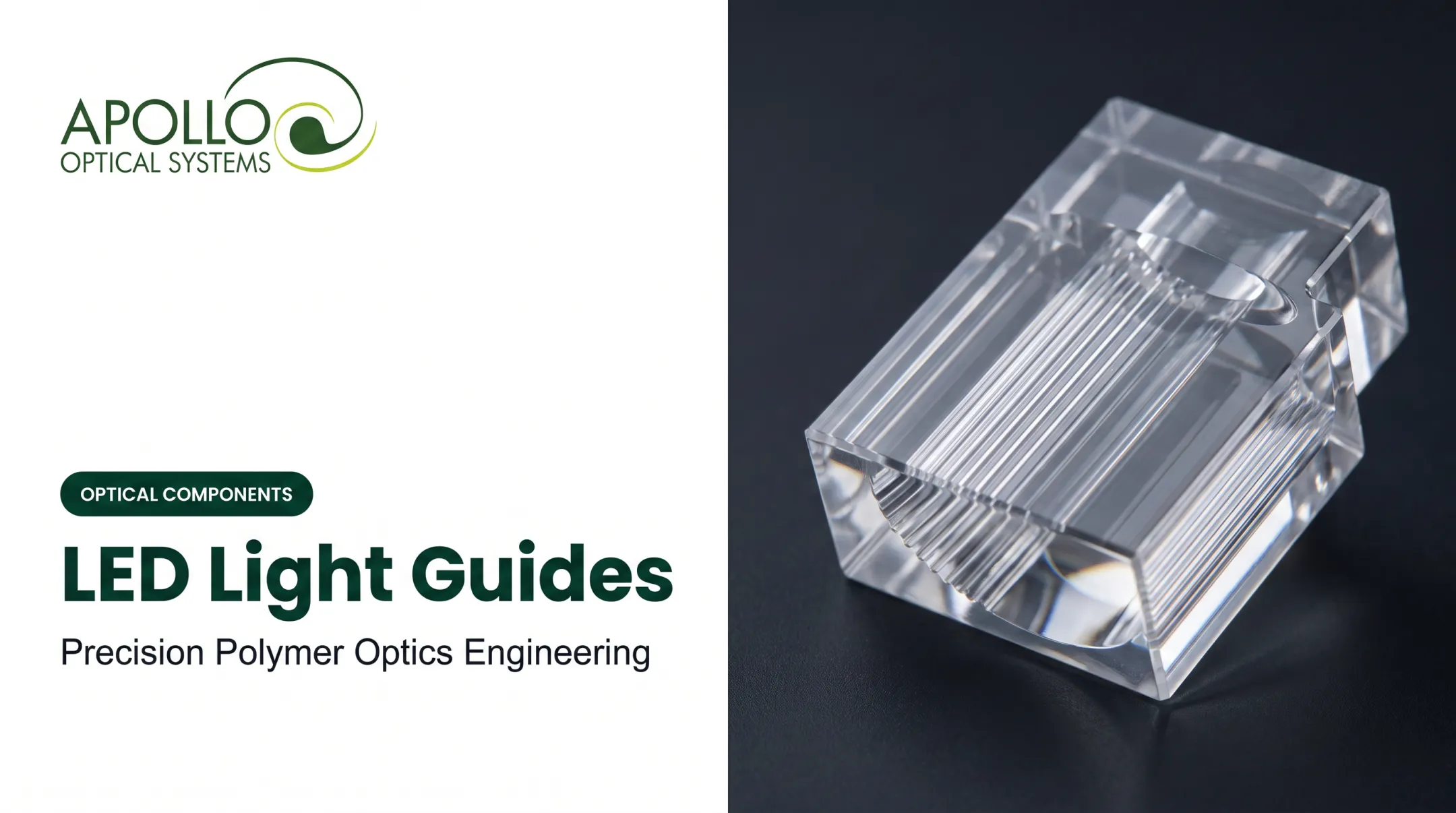

LGPs quietly power the visual experience in LCD backlights, automotive dashboards, illuminated control panels, and diagnostic medical displays. Each application brings its own tolerance requirements and durability demands.
This guide breaks down how LGPs work, the design variables that determine performance, material trade-offs, and what to look for in a manufacturing partner.
Key Takeaways
- LGP performance hinges on total internal reflection (TIR) paired with precisely engineered extraction features
- Material selection (PMMA vs. polycarbonate), panel thickness, and dot pattern density drive brightness uniformity
- Defense, medical, automotive, and consumer applications each carry distinct tolerance and durability demands
- A manufacturing partner with in-house engineering and prototyping reduces design risk and speeds development
What Is a Light Guide Panel?
A light guide panel is a transparent optical component, typically molded from PMMA (acrylic) or polycarbonate, that takes light injected at its edge and redirects it into a uniform planar glow. Instead of a single bright LED point, you get an evenly lit surface.
LGP vs. light pipe — what's the difference?
These terms get used loosely, but the functional distinction matters:
- Light guide panels spread light across a large, flat area such as LCD backlights or illuminated signage
- Light pipes transport light from a point (an LED) to a specific small target, such as an indicator light or button
Keysight's glossary notes the terms are sometimes used interchangeably in practice, so the panel-versus-pipe split is functional rather than a strict industry standard.
Common LGP applications include:
- LCD and display backlights
- Illuminated signage
- Automotive interior and dashboard lighting
- Backlit control panels and instrumentation
How Does a Light Guide Panel Work?
Total Internal Reflection Traps the Light
Light enters the panel edge and bounces internally, trapped by total internal reflection, until it strikes a feature designed to release it. TIR occurs when light hits a boundary at an angle steep enough that it can't escape; it reflects back into the material instead.
The critical angle depends on refractive index. PMMA runs around 1.49, while polycarbonate grades like Makrolon 2407 measure closer to 1.584. Keysight's example for an index of 1.5 against air puts the critical angle near 41.81 degrees. At angles of incidence above that threshold, light stays trapped.
Extraction Features Release Light at Controlled Points
Panels use laser-etched dots, printed patterns, or microstructures to disrupt TIR at controlled points. Because light naturally weakens the farther it travels from the source, designers increase dot density and size gradually across the panel to compensate.

Get this gradient wrong, and you'll see:
- Bright hotspots near the LED
- Dark "black hole" zones close to the source
- Uneven brightness fading toward the panel's far edge
Reflector Films Recycle Escaped Light
A back-reflective layer catches light that exits the wrong side of the panel and bounces it back through, improving overall efficiency rather than wasting it as heat or stray glow.
Simulation Before Tooling
Cutting a mold and discovering your dot pattern doesn't work is expensive. That's why ray-tracing simulation software models extraction feature layouts before any tooling gets cut, catching uniformity problems on a screen instead of in a production run.
Designing a Light Guide Panel: Key Considerations
Several variables interact to determine whether your panel produces even light or a patchwork of bright and dark zones.
Geometry and Light Source Placement
Panel shape (rectangular, tapered, curved, or custom automotive/medical geometries) changes how light propagates internally. Meanwhile, LED placement matters just as much:
- Single vs. dual edge-lit configurations affect achievable brightness and uniformity
- Narrower LED viewing angles and tighter LED-to-panel spacing reduce light loss at the input edge
In one published edge-lit study on a 6.2-inch panel, the nearest extraction dot sat 3.6 mm from the LED chip, with panel thickness of at least 1.79 mm, to hold uniformity and brightness targets.
Dot Pattern Gradient Design
The extraction pattern needs a density gradient that counteracts intensity falloff. A 2021 academic study using optical-grade PMMA and micro-injection molding measured:
| Design Stage | Measured Uniformity |
|---|---|
| No microstructures | ~52.4% |
| Primary microstructure design | ~66.8% |
| Optimized design | ~86.4% |
| That optimized result was nearly 1.65 times better than the no-microstructure baseline, which is why teams iterate the dot pattern in simulation before tooling. Supplier benchmarks for "good" uniformity often sit above 90%, but those figures are supplier-specific, not a universal standard. |

Thickness: The Brightness-vs-Rigidity Trade-off
Thinner panels help miniaturize the device but limit brightness and stiffness. Thicker panels couple more light and stay rigid, at the cost of bulk. Most production designs land between under 1 mm and a few millimeters—handheld and wearable optics skew thin; larger displays and industrial fixtures can afford more section.
Tolerance Requirements Vary by Industry
Aerospace displays and medical instrumentation can't tolerate inconsistent output. Precision polymer-optics molding often holds center thickness to ±0.015 mm and surface roughness below 50 Å RMS. Those figures show the control high-reliability LGP work can require; final tolerances still track the application.
Types of Light Guide Panels and Materials
Edge-Lit vs. Direct-Lit
Two lighting layouts dominate light guide panel design:
- Edge-lit: LEDs sit along the panel edge, so the assembly stays thin—common for backlights and control panels
- Direct-lit: Light sources sit behind the panel, used when thickness is less of a constraint
Material Trade-offs
| Property | PMMA (Acrylic) | Polycarbonate |
|---|---|---|
| Refractive index | ~1.49 | ~1.584 |
| Light transmission | ~92% | ~87-88% |
| Heat resistance (HDT) | ~117°C | ~124-136°C |
| Best suited for | Optical clarity, indoor use | Heat/impact-prone environments |
PMMA wins on optical clarity and light transmission. Polycarbonate wins where heat or impact resistance matters more, such as automotive dashboards baking in summer sun.

Manufacturing Method
- Injection molding suits high-volume production runs once a design is finalized
- Precision machining and diamond turning support custom, low-volume optics and are often used to cut molding inserts before full production
Applications Across Industries
Defense & Aerospace
Illuminated cockpit displays and tactical equipment demand rugged, consistent performance under extreme conditions. Aerospace edge-lit panels are commonly built to standards like MIL-DTL-7788, though optical construction details vary by program.
Medical & Life Sciences
Diagnostic device displays and surgical illumination require high precision and dependable output in critical-care settings. Apollo Optical Systems designs and manufactures optical components for endoscopes, illumination systems, and analytical instrumentation used in medical device manufacturing.
Automotive, Industrial & Consumer
Dashboard lighting, ambient interior lighting, and backlit control panels all rely on LGP technology. One automotive application used a thin custom polycarbonate light guide with proprietary micro-optics on a flex PCB assembly. The design illuminated dashboard fabric while improving energy efficiency.
Choosing the Right Manufacturing Partner for Custom Light Guide Panels
Catalog LGPs work for standard applications. Custom, high-precision designs need engineering depth, tight process control, and a partner who can carry the design from model to volume.
Why in-house engineering matters:
- Optical modeling and simulation (ZEMAX, CODE V, OSLO-class tools) catch uniformity problems before tooling
- Tolerance analysis and design-for-manufacture (DFM) reduce costly redesign cycles
- Rapid prototyping validates performance before committing to production volumes
Why end-to-end capabilities matter:
Having diamond turning, polymer injection molding, precision machining, and metrology under one roof cuts the vendor handoffs that slow development.
Apollo Optical Systems in Rochester, NY, runs this model with three single-point diamond turning lathes (one Innolite IL300, two Precitech Nanoform 200 units) for components from 1 mm to 300 mm in diameter, plus precision polymer injection molding in PMMA, polycarbonate, polystyrene, COC, and COP.

For engineered illumination light guides, that means:
- Custom optical design and modeling in-house
- SPDT-based prototyping before committing to production tooling
- Scalable injection molding once a design is validated
- In-house metrology (interferometers, profilometers) for surface figure and roughness verification
Defense, medical, and industrial buyers often need performance certainty and a domestic supply chain. A US-based precision optics manufacturer with decades of polymer optics experience lowers both technical risk and program risk.
Frequently Asked Questions
How do you design a light guide panel?
Start by defining your light source and panel geometry, then simulate extraction feature layout using ray tracing. Prototype the design, measure uniformity, and iterate until you hit your target performance.
How does a light guide work?
It uses total internal reflection to trap light entering at the edge. Extraction features—dots or microstructures placed across the surface—then release that light in a controlled pattern.
What are the different types of light guide panels?
The two main distinctions are edge-lit versus direct-lit configurations, and material type: primarily acrylic (PMMA) versus polycarbonate.
What is a light guide plate (LGP)?
A light guide plate is a transparent optical component that converts a point or line LED source into uniform surface illumination. It is commonly used in backlights, signage, and illuminated panels.
What materials are best for light guide panels?
PMMA offers superior optical clarity and light transmission, making it ideal for indoor displays. Polycarbonate handles higher heat and impact better, suiting automotive and rugged environments.
How thick should a light guide panel be?
Thickness depends on brightness requirements, available device space, and mechanical rigidity needs. Designs commonly range from under 1 mm for compact devices to several millimeters for higher-output applications.