
This is where TIR lenses come in. A TIR (total internal reflection) lens combines refraction and reflection into a single molded optic, capturing light other designs simply lose. This article breaks down the physics behind TIR lenses, the design variations available, and when off-the-shelf optics stop being good enough.
TIR optics now show up across defense targeting systems, surgical lighting, industrial equipment, and automotive headlamps, anywhere beam precision and efficiency both matter.
Key Takeaways
- TIR lenses pair a refractive center lens with a reflective outer surface, capturing nearly all light from an LED
- Total internal reflection—set by Snell's law and the critical angle—governs how TIR lenses shape the beam
- Molded from PMMA or polycarbonate, TIR lenses often outperform reflectors or projector lenses in beam control
- Catalog TIR lenses suit standard applications; custom optics handle tight tolerances or unusual beam requirements
What Is a TIR Lens?
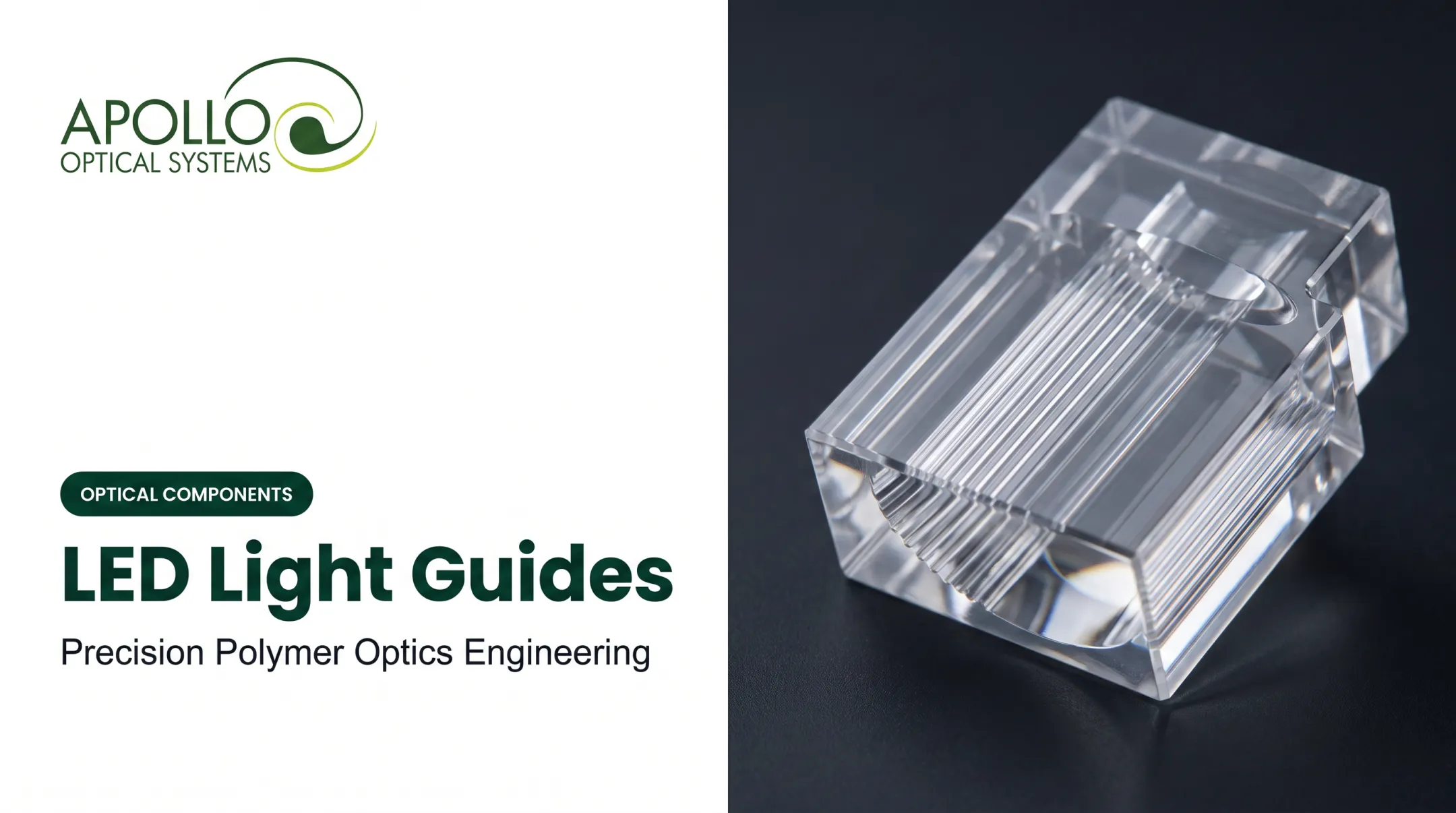
A TIR lens is a compound optic: a central refractive lens surrounded by an outer surface shaped to reflect light through total internal reflection. Both surfaces are molded as one piece.
The two zones split the work:
- Refractive core: manages light emitted close to the LED's optical axis
- TIR outer surface: captures wide-angle side light that would otherwise scatter without control
Because a TIR lens has two distinct optical surfaces working together, designers can correct more aberrations than a single-element lens or a basic reflector allows.

Materials and Manufacturing
- PMMA (acrylic): high clarity, low cost
- Polycarbonate: better heat resistance, higher refractive index
Both are almost always injection molded, which keeps unit costs low at volume while holding the precise surface geometry TIR optics demand.
That mix of optical control and scalable production is why these lenses show up in flashlights, automotive lighting, architectural fixtures, and medical devices.
How Total Internal Reflection Works
TIR starts with Snell's Law: n1 sin(θ1) = n2 sin(θ2), describing how light bends when it crosses between materials with different refractive indices.
Every interface between two materials has a critical angle that decides whether light exits or stays inside:
- Below that angle, light refracts and exits
- Beyond it, light can't escape at all—it reflects entirely back into the denser material, as if the surface were a perfect mirror
TIR lens designers exploit this deliberately. The outer surface curvature is engineered so that side-emitted light hits the interface beyond the critical angle every time, then bounces into a precisely controlled beam pattern.

Unlike metallic reflectors, which absorb some light on every bounce, TIR doesn't lose light to absorption. A 2018 study published in the Journal of Optoelectronics and Advanced Materials measured a designed TIR lens at 95.69% optical efficiency at a 30-degree beam angle, using a goniophotometer.
That said, TIR isn't automatically superior in every case. A 2015 study in Optica compared TIR lenses against reflectors across multiple test systems and found efficiencies within a few percentage points of each other, sometimes with reflectors edging ahead. Efficiency depends heavily on geometry, LED source, and the number of optical elements—not the architecture alone.
TIR Lenses vs. Reflectors vs. Projector Lenses
Each approach handles LED light differently.
- Reflectors only control light that strikes their surface. Missed rays go uncontrolled and create glare—simple and affordable, but limited.
- Projector lenses create sharp beam cutoffs, useful for automotive low-beam headlamps, but they waste light absorbed inside the housing before it reaches the lens.
- TIR lenses combine both approaches: the refractive core handles direct light while the outer TIR surface captures side light, all within one molded part.
| Optic Type | Beam Control | Glare Risk | Design Complexity | Relative Cost |
|---|---|---|---|---|
| Reflector | Moderate | Higher (uncontrolled side light) | Low | Low |
| Projector Lens | High (sharp cutoff) | Low | Moderate | Moderate |
| TIR Lens | High (captures both direct + side light) | Low | High | Moderate-High |
That higher design complexity is the trade-off. TIR lenses need precise mold geometry and tight tolerances to work correctly—so engineering partners with molding and metrology capability matter for custom builds.

Types of TIR Lens Beam Patterns and Designs
TIR lenses ship in several standard beam categories, each tuned for throw distance and coverage:
- Narrow spot: concentrated, high-intensity beam for long throw
- Medium beam: balanced spread for general task lighting
- Wide: broad coverage with lower peak intensity
- Oval/asymmetric: non-circular patterns for roadway, shelf, and similar linear applications
Surface texture
Surface finish reshapes the same optic’s output:
- Smooth surfaces produce crisp, defined beams
- Diffused surfaces improve color mixing but increase glare risk
- "Pillow" textures soften the beam and widen distribution while lowering peak intensity
Mounting and arrays
Mounting style matters as much as the optical prescription. Common options include:
- Holders, integrated legs, or rims that change PCB footprint and sealing against moisture or dust
- Single lenses paired with individual LEDs
- Multi-lens arrays that cover LED clusters in one assembly
Why Manufacturers Choose Custom TIR Optics
Catalog TIR lenses work fine for standard flashlights or general task lighting. But defense, medical, and aerospace applications often push past what off-the-shelf parts can deliver, whether that's a unique beam profile, tighter tolerances, or a specific coating stack.
Custom TIR lens production demands real manufacturing depth:
- Precision injection molding for consistent, high-volume optical parts
- Single-point diamond turning for prototype inserts and low-volume runs
- In-house metrology to verify dimensional and optical accuracy before parts ship
Apollo Optical Systems, based in Rochester, NY, builds custom TIR optics using this exact combination. Its polymer injection molding supports both prototype and high-volume runs.
Three diamond-turning lathes—an Innolite IL300 and two Precitech Nanoform 200 machines—produce optical inserts from 1 mm to 300 mm in diameter. In-house metrology, including CMM systems and interferometers, verifies surface accuracy before parts move to production.

Apollo also offers in-house thin-film coating, covering anti-reflection, mirror, and filter coatings across UV, visible, and near-infrared ranges, which matters when a TIR lens needs more performance than an uncoated polymer surface can deliver.
Material choice tracks the application:
- PMMA and polycarbonate — common, cost-effective options for many lighting designs
- COC (cyclic olefin copolymer) — often preferred for medical and diagnostic optics thanks to high transmission and low birefringence
Bring a manufacturing partner in during design—not after the beam profile is locked—to avoid costly redesigns and keep development timelines on track.
Frequently Asked Questions
What is a TIR lens?
A TIR lens is a compound optic that combines refraction and total internal reflection in a single molded piece. It controls both the direct and side-emitted light from an LED source, unlike simple lenses that only manage direct light.
What is total internal reflection (TIR) in optics?
TIR occurs when light traveling inside a denser material hits an interface at an angle beyond the critical angle. Instead of exiting, it reflects entirely back into the material, with no light escaping through that surface.
What is TIR LED?
"TIR LED" refers to an LED paired with a TIR lens optic. The lens shapes and directs the LED's raw output into a controlled beam pattern, rather than letting light scatter unmanaged.
What type of lens is PMMA?
PMMA, or acrylic, is an optical-grade polymer widely used to mold TIR and other LED lenses. It offers strong clarity, roughly 92% transmission at 550 nm, and molds cleanly at scale.
What is the point of a reflector?
A reflector redirects side-emitted LED light forward into a beam. However, it can only control light that actually strikes its surface, leaving anything that misses uncontrolled and prone to glare.
What is the price of a TIR lens?
Cost varies widely between catalog lenses and custom-tooled optics. Volume, material choice, tolerance requirements, and mold complexity all factor into final pricing, so getting an accurate quote requires specifying these details upfront.