
Engineers sourcing these assemblies face a real tension: optical performance, mechanical complexity, and manufacturability at scale rarely pull in the same direction. Push tolerances too tight and yields collapse. Loosen them and image quality suffers.
This guide breaks down how zoom lens assemblies work, what's inside them, the design and manufacturing tradeoffs that matter, and how to pick a partner who can deliver at volume.
Key Takeaways
- Coordinated moving groups (variator, compensator, focus) change focal length without losing focus
- Complexity compounds fast: tilt and decenter errors stack across every moving group in the assembly
- Monte Carlo tolerancing and compensator-informed design improve as-built optical performance
- Defense, medical, and industrial applications each demand different durability and precision standards
- An experienced manufacturing partner cuts alignment risk and shortens time-to-market
What Is a Zoom Lens Assembly?
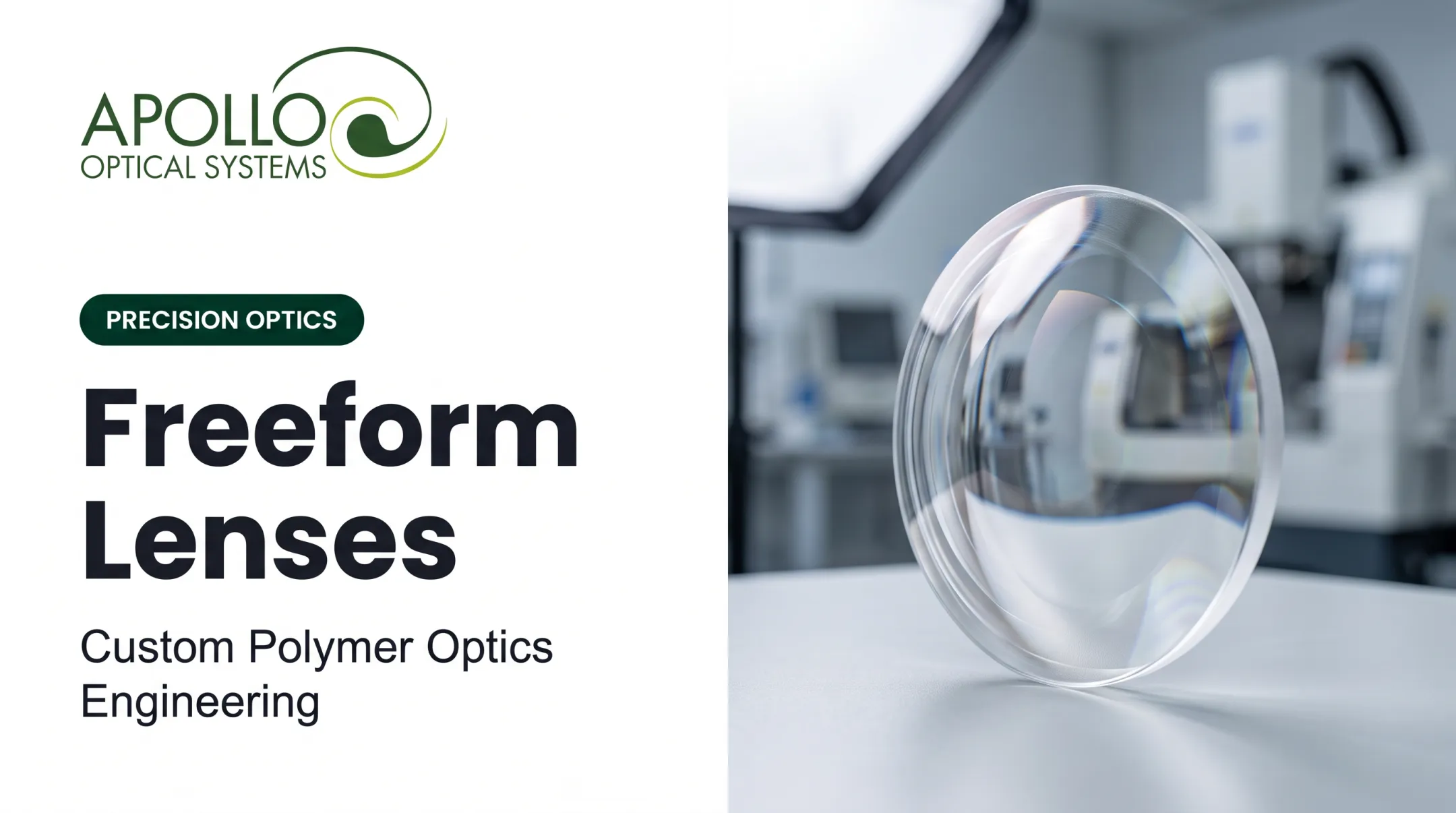
A zoom lens assembly is an optomechanical system of lens elements and groups, mechanical housings, and drive mechanisms that work together to produce a continuously variable focal length. Unlike a prime lens, which is fixed to one focal length, a zoom lens covers a range.
That range is described by a simple ratio:
Zoom ratio = maximum focal length ÷ minimum focal length
For example, a 10–100 mm assembly delivers a 10:1 zoom ratio.
There's an important distinction buried in that math. A true zoom maintains focus throughout the zoom range — engineers call this parfocal behavior. A varifocal lens changes focal length too, but typically needs refocusing afterward (RP Photonics).
If your application can't tolerate a refocus step between focal lengths, parfocal performance needs to be a pass/fail spec, not a nice-to-have.
Inside the housing, a zoom assembly integrates:
- Multiple lens groups (each with distinct optical jobs)
- Cam or helicoid mechanisms that translate rotation into precise axial movement
- An aperture/iris unit controlling light throughput
- A mounting interface connecting the assembly to the camera or sensor
How Does a Zoom Lens Assembly Work?
Zoom performance comes down to coordinated motion between a small number of functional groups—the optics that set focal length and the mechanics that move them in lockstep.
The Core Optical Groups
- Variator (zoom group): Moves axially to change focal length and magnification
- Compensator: Moves with the variator to hold the image plane steady during zoom
- Focus group: A separate group that handles focus adjustment independent of zoom position
- Master/relay group: Corrects residual aberrations and relays the image to the sensor plane, often housing the aperture diaphragm That compensator motion is what makes a zoom parfocal rather than varifocal, keeping focus stable as focal length changes (University of Arizona study). Optical vs. mechanical compensation decides how those groups move. In optical compensation, variator and compensator travel at matched rates. In mechanical compensation, they follow different paths (often cam-guided), with one moving linearly and the other nonlinearly. Some advanced designs move several groups at once along nonlinear paths. That improves compactness and off-axis aberration correction, but it adds real mechanical complexity.

The Mechanical Drive System
Nested barrels, cam slots, and cam followers physically move each group during zooming. This is where backlash, hysteresis, and repeatability either hold up or fall apart. A prescription that looks perfect in Zemax can still underperform if the drive mechanism can't repeat its motion path precisely across thousands of zoom cycles. Treat the optical prescription and the mechanical motion law as two linked specs. Then test focus stability across the full zoom travel, not just at the endpoints.
Key Parts of a Zoom Lens Assembly
There is no universal part count for a zoom lens assembly. It depends on prescription, packaging, and actuator design. One frequently cited 10x zoom design uses four or five lens groups, with three elements in a single group alone.
A functional bill of materials generally includes:
- Optical elements and groups: individual lenses, cemented doublets/triplets, and anti-reflective or flare-reducing coatings
- Mechanical housings and barrels: retaining rings, spacer rings, and helicoids that convert rotation into axial travel
- Aperture/iris mechanism: links to the aperture ring to control light throughput
- Focus and zoom rings: user- or motor-driven interfaces that engage the cam and helicoid systems
- Mount/housing interface: secures the assembly to the camera or larger system
Skip generic part-count benchmarks. Request a controlled BOM and exploded drawing for your design. Apollo Optical Systems, for example, has assembled polymer optical products from simple UV-bonded doublets up to 34-element endoscope assemblies, so conventional part counts vary widely by application.
Design and Manufacturing Considerations
This is where zoom assemblies live or die. Multi-group systems compound errors in ways single-element optics never do.
Tolerancing Isn't Optional
Tilt, decenter, and despace in one lens cell get inherited by every group downstream. A 2011 opto-mechanical tolerance study using a 10x zoom as its case example found that simulated tilt increased with assembly order — meaning errors introduced early in the build get amplified later (ScienceDirect).
Monte Carlo simulation helps quantify this before cutting metal. A 2018 Optica study ran 10,000 trials with 250-micron radial decenters and compensators for decenter, focus, and tilt. The result: mean wavefront error improved from 0.808/0.889 lambda (conventional optimization) to 0.502/0.518 lambda with tolerance/compensator-informed optimization (Optica). Better tolerance modeling alone produced that as-built gain.

Edge thickness and centering accuracy on individual elements set the ceiling for the full assembly. Loose element-level tolerances pass straight through as final tilt and decenter—so manufacturable geometry has to be locked before groups stack up.
Precision Fabrication Routes
Two processes dominate high-precision polymer optics:
| Process | Center thickness | Concentricity | Surface roughness |
|---|---|---|---|
| Injection molding | ±0.025 mm | 0.025 mm | <75 Å RMS |
| Single-point diamond turning | ±0.015 mm | 0.015 mm | <50 Å RMS |

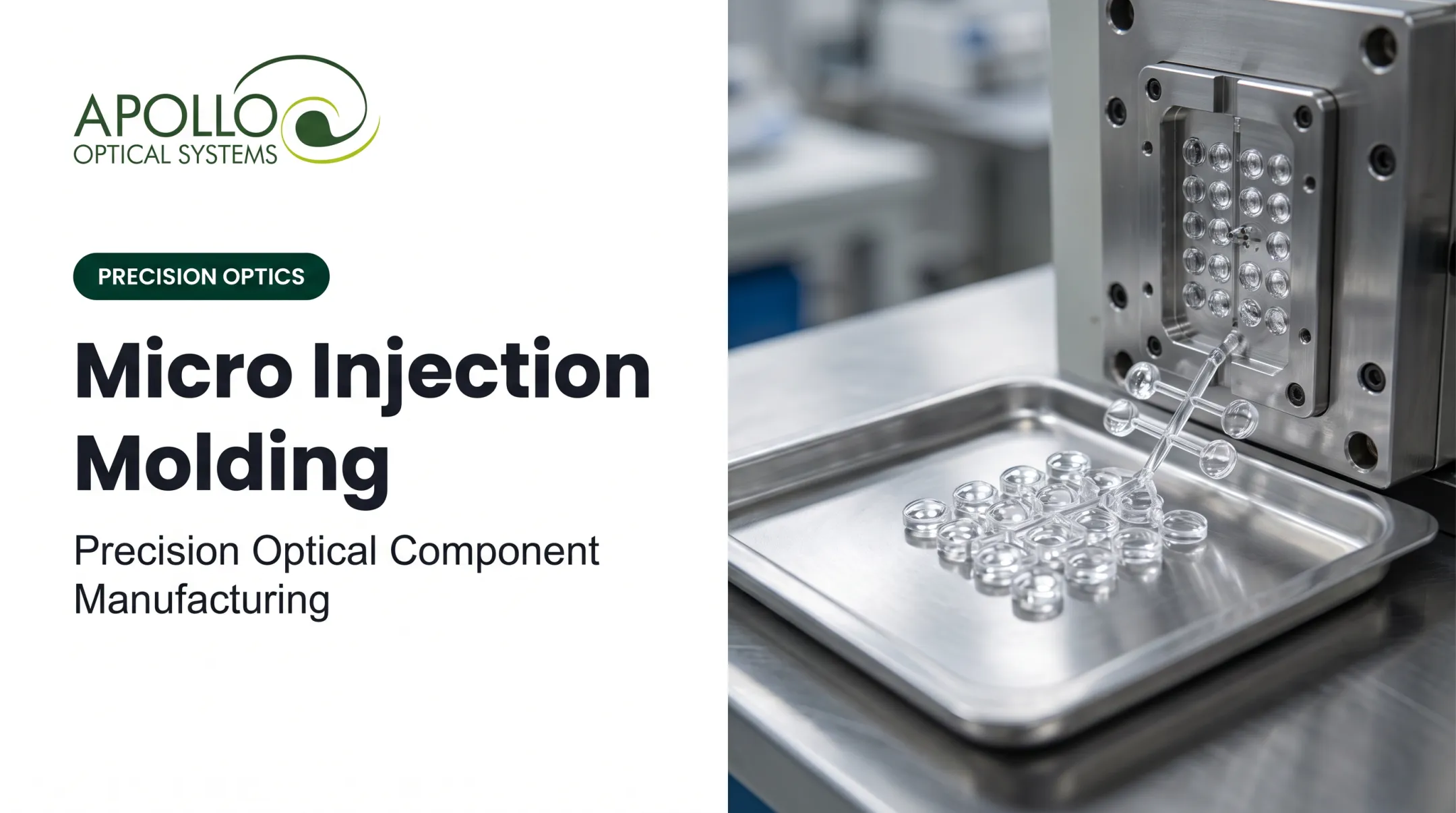
Diamond turning typically covers prototyping, tooling inserts, and low-to-mid volume runs. Injection molding scales to high-volume production once the design is locked.
Apollo Optical Systems runs both single-point diamond turning and polymer injection molding in-house, with supporting precision machining, coating, and metrology. Keeping prototype and production paths under one roof avoids vendor changes and re-qualifying tooling mid-program.
Applications Across Industries
Zoom assemblies earn their added complexity only when changing field of view or magnification creates real operational value.
- Defense & aerospace: MWIR continuous-zoom assemblies for targeting and surveillance must hold alignment under vibration, temperature swings, and shock—e.g., Teledyne FLIR's MWIR CZ 15-300 (15–300mm, 3.6–4.9 µm) (Teledyne FLIR).
- Medical & life sciences: Surgical microscopes use zoom optics for variable magnification in neurosurgery and ENT; endoscopy packs zoom/focus actuators into working diameters as tight as 10mm.
- Industrial & consumer: Machine-vision zoom lenses change magnification without swapping optics, which suits semiconductor and LCD inspection; smartphones now pack true optical zoom into compact modules.

Medical is where Apollo Optical Systems has the deepest documented assembly history, including multi-element builds up to 34 elements for endoscopic applications. That record shows tight-tolerance, multi-group optical assembly can scale in a regulated environment.
Choosing a Manufacturing Partner for Zoom Lens Assemblies
The biggest risk in zoom assembly isn't surface quality on any single element — it's wedge, roll, and decenter compounding across the build (Vision Systems Design). A partner needs to demonstrate control over element centering, cell datums, and image-axis alignment, verified with post-assembly metrology at multiple zoom positions, not just incoming inspection.
Supply chain continuity matters just as much. Sourcing critical components and materials remains one of the top threats facing photonics manufacturers. Before committing to a partner, verify:
- Single-source risk — identify which glass, polymer, coating, or tooling suppliers have no approved alternate
- Tooling ownership — confirm who owns and maintains molds, fixtures, and test software
- Traceability — require lot records, first-article data, and nonconformance history
- Capacity and continuity — review lead times and disaster recovery plans before ramping volume
Apollo Optical Systems runs these controls from a 21,000 sq. ft. facility in Rochester, NY, with roots in the 1989 Rochester Photonics Corporation spin-off from the University of Rochester's Institute of Optics. Design support and production sit under one roof:

- Single-point diamond turning
- Polymer injection molding and assembly
- Precision machine shop
- Coating and metrology
Volumes span one-off prototypes to hundreds of thousands of units per month under ISO, FDA, and GMP protocols. For teams weighing build-versus-buy on a zoom program, fewer handoffs between prototype and shipping product means less alignment drift and lower supply-chain risk.
Frequently Asked Questions
How does a zoom lens work?
A zoom lens changes focal length by moving a variator group, while a compensator group moves in tandem to keep the image plane stationary. This coordinated motion makes the lens parfocal instead of requiring refocus at each zoom position.
What are the parts of a zoom lens?
Core components include multiple optical groups (variator, compensator, focus, master), a cam or helicoid drive mechanism, an aperture/iris unit, focus and zoom rings, and a mount interface. Exact part counts vary by prescription and application.
How much does a zoom lens cost?
Cost depends heavily on tolerance complexity, material choice, tooling approach, and production volume. Custom zoom assemblies for defense, medical, or industrial use require quoting against specific requirements rather than a general price range.
What is the difference between a zoom lens and a prime lens?
A prime lens has one fixed focal length and no moving zoom groups, making it simpler and often sharper at that single setting. A zoom lens trades that simplicity for a continuous focal-length range, at the cost of added optical and mechanical complexity.
Why is tolerancing important in zoom lens assembly manufacturing?
Tilt and decenter errors introduced in individual elements compound across every moving group in a zoom assembly. Monte Carlo tolerance analysis with compensator-informed optimization reduces as-built wavefront error versus conventional design methods.
What industries rely on custom zoom lens assemblies?
Defense and aerospace use zoom optics for targeting and surveillance. Medical systems (surgical microscopes, endoscopy), industrial machine vision, automotive, and consumer electronics each bring distinct tolerancing and durability requirements.