
The US precision optics manufacturing sector generated an estimated $7.5 billion in 2024 sales, according to a Kentley Insights commercial market report. That's a lot of glass and polymer moving through grinding wheels, molds, and coating chambers.
Here's the distinction that trips up a lot of buyers: consumer eyewear lens producers and precision/technical optics manufacturers are not the same industry. Eyewear lenses serve vision correction. Precision optics serve defense guidance systems, surgical robotics, and industrial inspection equipment, where a few microns of error can mean device failure.
This guide ranks the top optical lens manufacturers and industry leaders for 2024, focused specifically on precision and technical optics.
TL;DR
- Optical lens manufacturing splits into consumer eyewear and precision/technical optics for defense, medical, and industrial markets
- Selection criteria that matter: technology capability, certifications, scalability, and end-to-end manufacturing
- Apollo Optical Systems and other specialists lead in precision polymer optics for demanding applications
- Match manufacturer capabilities to your application before shortlisting suppliers
Overview of the Optical Lens Manufacturing Industry in the US
Optical lens manufacturing in the US supports medical devices, defense systems, automotive sensors, and consumer electronics. The work covers a full chain of processes:
- Surfacing and grinding — shaping blanks into spherical, flat, or aspherical forms
- Molding — heating and pressing glass or polymer into precision shapes, especially for aspheric elements
- Coating — applying thin films for anti-reflection, filtering, or reflective properties
- Metrology — measuring surface figure, roughness, and dimensional accuracy, often non-contact and in-process
Each step feeds directly into end-use performance. A surgical endoscope lens with a coating defect distorts diagnostic images. A defense sight with an out-of-spec aspheric surface misses its target range.
The manufacturers below are chosen for precision, reliability, and technical capability—not headcount or revenue rank. In applications where "close enough" isn't acceptable, those traits decide who leads.
Top Optical Lens Manufacturers and Industry Leaders in the US
Companies were evaluated on five factors: manufacturing precision, technological capability, certifications, industry reputation, and end-to-end capabilities (design through volume production).
Apollo Optical Systems
Apollo traces its roots to Rochester Photonics Corporation, a 1989 spin-off from the University of Rochester's Institute of Optics. After Corning acquired and later closed the business in 2002, a management buyout created Apollo Optical Systems on December 31, 2002. Today the company operates a 21,000 sq. ft. facility in Rochester, NY.
Standout capabilities:
- Single-point diamond turning: three lathes (Innolite IL300, two Precitech Nanoform 200) for 1–300mm parts, finishes to 13 Å RMS in nickel
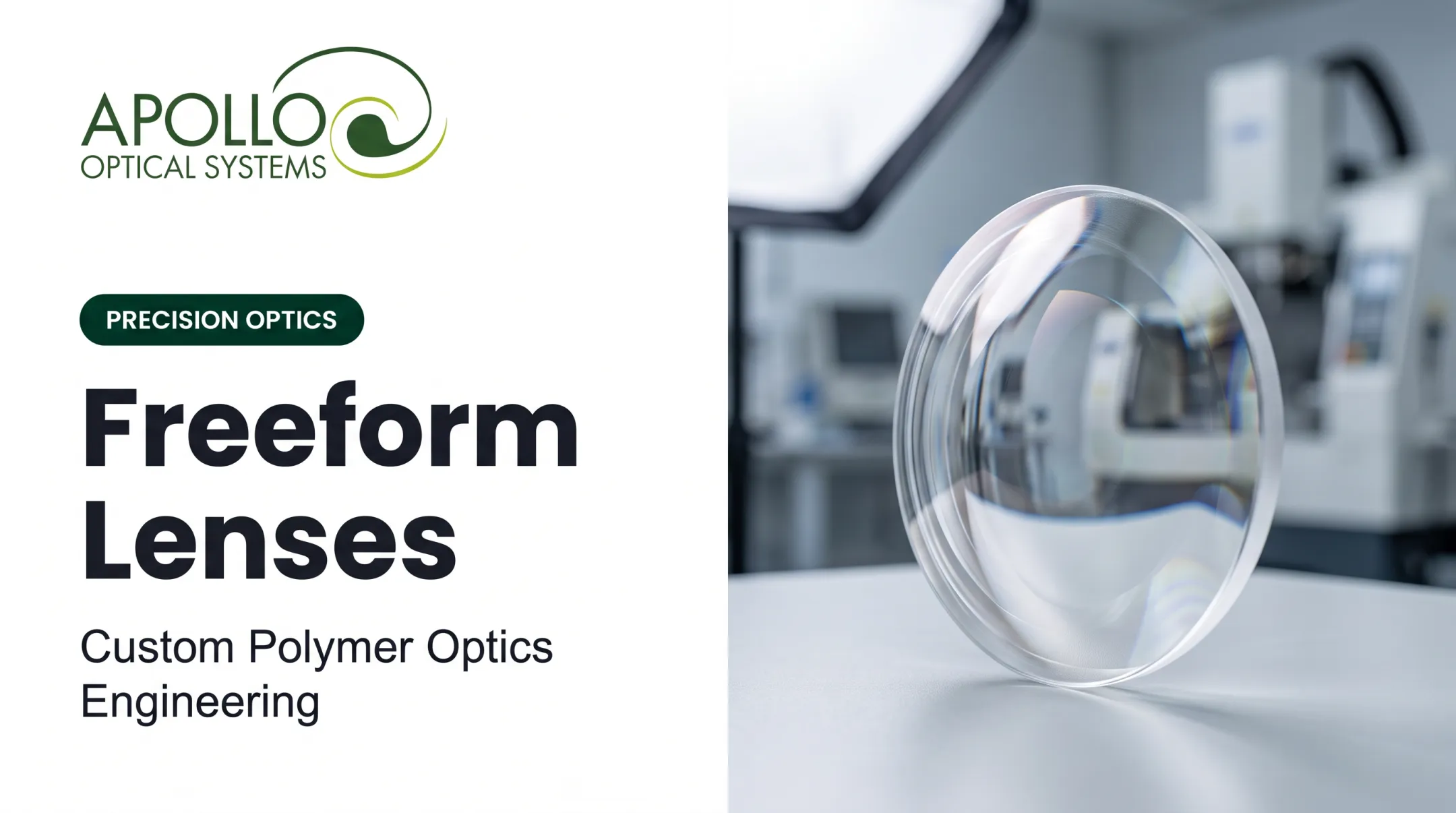
- Polymer injection molding: spherical, aspheric, Fresnel, and diffractive surfaces in COC, COP, and high-temperature polyimides
- In-house coating and metrology: evaporative AR/reflective coatings with Zygo interferometers and a Zeiss Contura G2 CMM
Apollo recently secured a new medical tooling and injection-molding program with a top-five global women's health company, adding to work spanning night-vision systems, endoscopes, and robotic-surgery optics.
| Technical Specs | Key Features | Best For |
|---|---|---|
| SPDT, injection molding, coating, in-house metrology | End-to-end production, ISO 13485:2016, 25+ years polymer optics | Defense, medical, industrial, automotive optics |

ZEISS Group
ZEISS opened its first precision workshop in Jena in 1846, initially focused on microscopes. It's now a dominant force in surgical visualization and semiconductor lithography.
Where ZEISS leads:
- UVProtect Technology for eyewear lenses, extending UV protection to 400nm
- AI-supported diagnostics across surgical microscopy and industrial image analysis
- Lithography optics that set minimum printable structures in semiconductor manufacturing
| Technical Specs | Key Features | Best For |
|---|---|---|
| Surgical visualization, AI analysis, lithography optics | 175+ years optical heritage; medical and semiconductor strength | Surgical imaging, lithography, industrial inspection |
Corning Incorporated
Corning dates back to 1851 and invented the first low-loss optical fiber in 1970. Its Optical Communications segment made up 30% of segment net sales in 2023, per its 2023 Form 10-K filing.
Core strengths:
- Materials science R&D across 10+ dedicated facilities
- Advanced glass for telecom, aerospace, and semiconductor markets
- Precision inspection optics for demanding industrial environments
| Technical Specs | Key Features | Best For |
|---|---|---|
| Specialty glass, optical fiber, semiconductor materials | Century-plus R&D, global manufacturing scale | Telecom, aerospace/defense, semiconductor components |
Edmund Optics
Founded by Norman Edmund in 1942, Edmund Optics has grown into a photonics supplier with more than 28,900 unique products in its catalog.
Why it stands out:
- Large standard catalog plus custom build-to-print manufacturing
- Roughly 2.5 million customized optical components produced annually
- Support from design and prototyping through tooling and volume production
| Technical Specs | Key Features | Best For |
|---|---|---|
| Catalog + custom manufacturing, magnetorheological finishing | Broad catalog, fast prototyping | Research labs, industrial clients, rapid prototypes |
Nikon Corporation
Nikon introduced its first camera lens with an aspherical element in 1968 and has since built out precision glass molding, ultra-low dispersion glass, and nanometer-level manufacturing for semiconductor lithography.
Technical edge:
- Precision Glass Molding for aspheric elements at scale
- ED (extra-low dispersion) glass that cuts chromatic aberration
- Digital mold technology targeting 10nm surface variation in polishing
| Technical Specs | Key Features | Best For |
|---|---|---|
| Aspheric molding, ED glass, Nano Crystal Coat | Decades of imaging-optics work, nanometer precision | High-resolution imaging, semiconductor lithography |

How We Chose the Best Optical Lens Manufacturers
The most common buyer mistake? Picking a manufacturer based on brand recognition rather than technical fit. A well-known optics brand isn't automatically the right partner for a niche polymer molding project.
We weighed manufacturers against:
- Manufacturing scale: prototype runs through hundreds of thousands of units monthly
- Certifications and compliance: ISO 13485 for medical devices and industry-specific quality standards
- Material and coating capabilities: glass, polymer, high-index materials, and thin-film coatings
- Client base and reputation: proven work in defense, medical, or industrial applications
- Volume quality: consistent performance at scale, not capacity alone

Only manufacturers that met most or all of these criteria made the list.
Conclusion
Choosing an optical lens manufacturing partner comes down to matching technical capability with your specific application, not chasing brand names. A company excellent at glass lithography optics may not be the right fit for high-volume polymer molding, and vice versa.
Before committing, pressure-test these points:
- Scalability for your volume path
- Quality consistency across lots
- Long-term supply chain reliability
- Surface finish tolerances and in-house metrology
- Certifications relevant to your industry
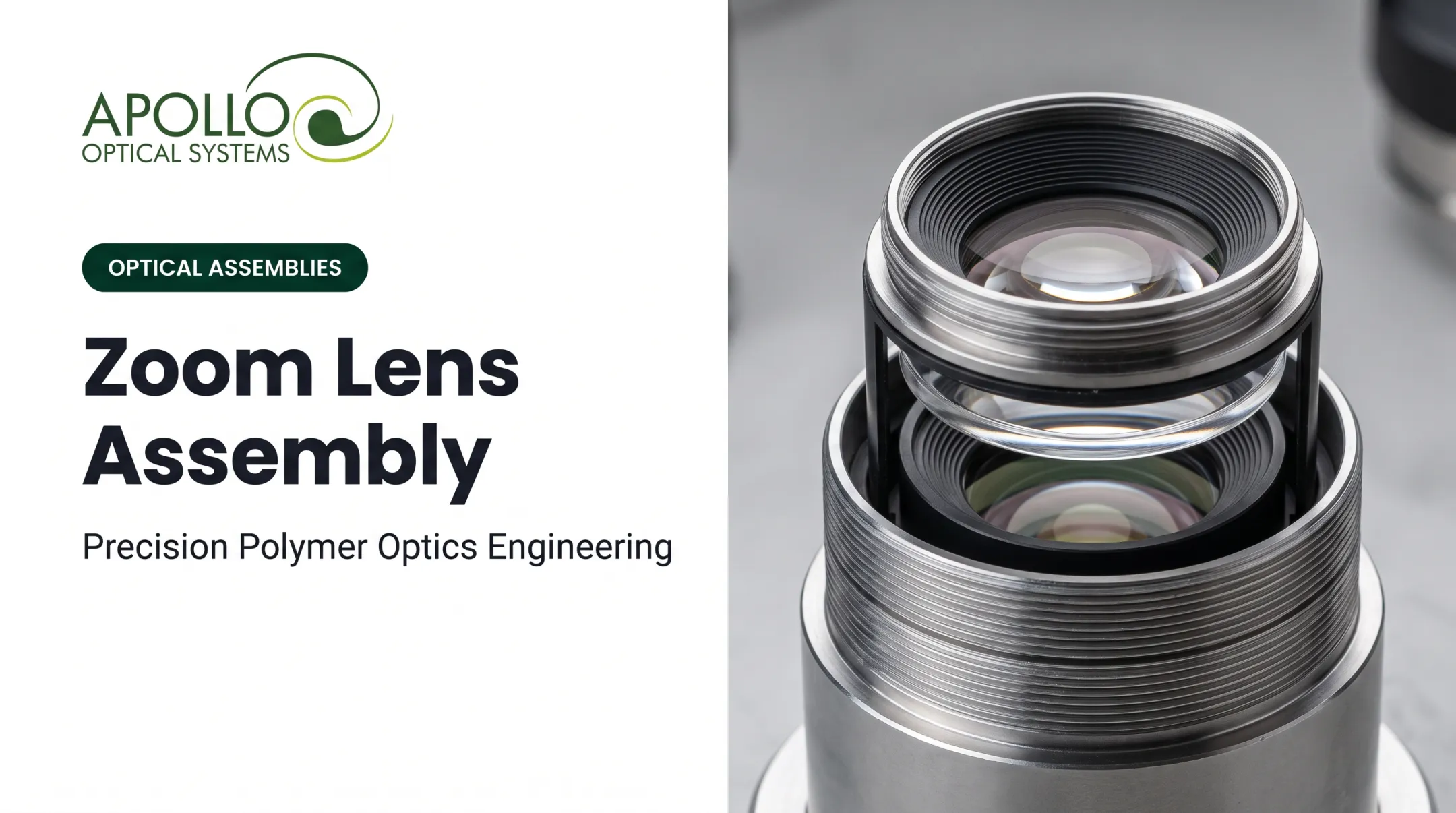
Apollo Optical Systems offers end-to-end precision polymer optics manufacturing—from single-point diamond turning through injection molding, coating, and assembly—for defense, medical, and industrial applications. To match your specs with a secure production path, reach out to Apollo Optical Systems.
Frequently Asked Questions
What is the difference between precision optics and standard eyeglass lenses?
Precision optics are engineered for specialized technical applications like defense imaging and medical devices, requiring far tighter tolerances than standard eyewear. Surface figure and roughness specs are measured in angstroms, not millimeters.
Who are the largest optical lens manufacturers globally?
Major global players include ZEISS, SCHOTT, Canon, and Nikon, according to a Maximize Market Research report. ZEISS focuses heavily on lithography and surgical optics, while Nikon leads in imaging and semiconductor precision.
What materials are commonly used in optical lens manufacturing?
Glass remains standard for high-durability, high-index applications. Polymers like PMMA, polycarbonate, and COC/COP offer lighter weight and cost-effective molding for high-volume production, while high-index materials reduce the need for extreme lens curvature.
How do I choose the right optical lens manufacturer for my industry?
Prioritize certifications relevant to your sector (ISO 13485 for medical), demonstrated technical capability in your required process, and proven scalability. Industry-specific experience matters more than general reputation.
What industries rely most on precision optical lens manufacturing?
Defense, medical devices, industrial inspection systems, and automotive optics represent the core sectors demanding precision optical components. Each has distinct tolerance and certification requirements.
How has optical lens manufacturing technology evolved recently?
Recent advances include high-precision aspheric-diffractive mold fabrication and plasma-based coatings spanning UV to infrared. Increased automation in beveling and part handling has also improved performance and production scalability.